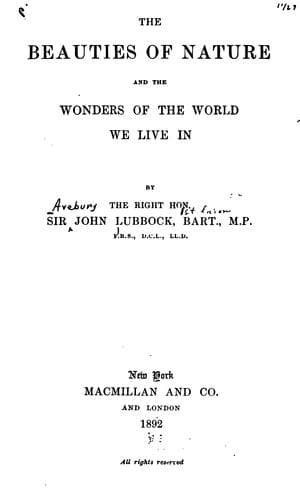
The Beauties of Nature, and the Wonders of the World We Live InLubbock, John, Sir
Philosophy
The Beauties of Nature, and the Wonders of the World We Live In
Lubbock, John, Sir
Astronomy; Natural history; Physical geography
Whenever ships have sailed southwards, except at a few places where land
has been met with, they have come at last to a wall of ice, from fifty
to four hundred feet high. In those regions it snows, if not
incessantly, at least very frequently, and the snow melts but little. As
far as the eye can reach nothing is to be seen but snow. Now this snow
must gradually accumulate, and solidify into ice, until it attains such
a slope that it will move forward as a glacier. The enormous Icebergs of
the Southern Ocean, moreover, show that it does so, and that the snow of
the extreme south, after condensing into ice, moves slowly outward and
at length forms a wall of ice, from which Icebergs, from time to time,
break away. We do not exactly know what, under such circumstances, the
slope would be; but Mr. Croll points out that if we take it at only half
a degree, and this seems quite a minimum, the Ice cap at the South Pole
must be no less than twelve miles in thickness. It is indeed probably
even more, for some of the Southern tabular icebergs attain a height of
eight hundred, or even a thousand feet above water, indicating a total
thickness of the ice sheet even at the edge, of over a mile.
Sir James Ross mentions that--"Whilst measuring some angles for the
survey near Mount Lubbock an island suddenly appeared, which he was
quite sure was not to be seen two or three hours previously. He was much
astonished, but it eventually turned out to be a large iceberg, which
had turned over, and so exposed a new surface covered with earth and
stones."
The condition of the Arctic regions is quite different. There is much
more land, and no such enormous solid cap of ice. Spitzbergen, the land
of "pointed mountains," is said to be very beautiful. Lord Dufferin
describes his first view of it as "a forest of thin lilac peaks, so
faint, so pale, that had it not been for the gem-like distinctness of
their outline one could have deemed them as unsubstantial as the spires
of Fairyland."
Public-domain text, read in full here on John Shaqi.
Reviews
Reviews
No reviews yet
Be the first to share your thoughts on this work.
Elsewhere in the archive
Join the Discussion
Join the discussion
Sign in to leave a comment or review.
Sign InorCreate an account