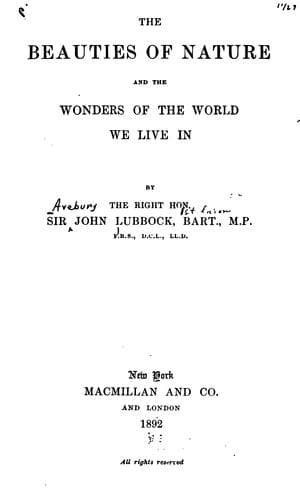
The Beauties of Nature, and the Wonders of the World We Live InLubbock, John, Sir
Philosophy
The Beauties of Nature, and the Wonders of the World We Live In
Lubbock, John, Sir
Astronomy; Natural history; Physical geography
Another stupendous problem connected with the Sun is the fact that, as
geology teaches us, it has given off nearly the same quantity of light
and heat for millions of years. How has this come to pass? Certainly not
by any process of burning such as we are familiar with. Indeed, if the
heat of the Sun were due to combustion it would be burnt up in 6000
years. It has been suggested that the meteors, which fall in showers on
to the Sun, replace the heat which is emitted. To some slight extent
perhaps they do so, but the main cause seems to be the slow condensation
of the Sun itself. Mathematicians tell us that a contraction of about
220 feet a year would account for the whole heat emitted, and as the
present diameter of the Sun is about 860,000 miles, the potential store
of heat is still enormous.
To the Sun we owe our light and heat; it is not only the centre of our
planetary system, it is the source and ruler of our lives. It draws up
water from the ocean, and pours it down in rain to fill the rivers and
refresh the plants; it raises the winds, which purify the air and waft
our ships over the seas; it draws our carriages and drives our
steam-engines, for coal is but the heat of former ages stored up for our
use; animals live and move by the Sun's warmth; it inspires the song of
birds, paints the flowers, and ripens the fruit. Through it the trees
grow. For the beauties of nature, for our food and drink, for our
clothing, for our light and life, for the very possibility of our
existence, we are indebted to the Sun.
Public-domain text, read in full here on John Shaqi.
Reviews
Reviews
No reviews yet
Be the first to share your thoughts on this work.
Elsewhere in the archive
Join the Discussion
Join the discussion
Sign in to leave a comment or review.
Sign InorCreate an account