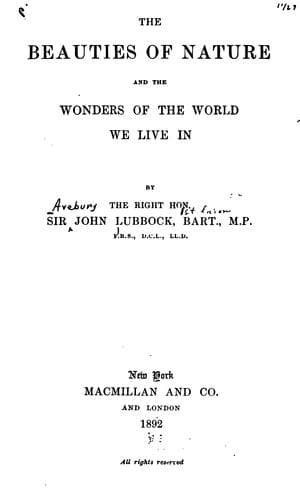
The Beauties of Nature, and the Wonders of the World We Live InLubbock, John, Sir
Philosophy
The Beauties of Nature, and the Wonders of the World We Live In
Lubbock, John, Sir
Astronomy; Natural history; Physical geography
But even more again, we revolve annually round the Sun in a mighty orbit
580,000,000 miles in circumference. In this respect we are moving at the
rate of no less than 60,000 miles an hour, or 1000 miles a minute--a
rate far exceeding of course, in fact by some 100 times, that of a
cannon ball.
How few of us know, how little we any of us realise, that we are rushing
through space with such enormous velocity.
MARS
To the naked eye Mars appears like a ruddy star of the first magnitude.
It has two satellites, which have been happily named Phobos and
Deimos--Fear and Dismay. It is little more than half as large as the
Earth, and, though generally far more distant, it sometimes approaches
us within 35,000,000 miles. This has enabled us to study its physical
structure. It seems very probable that there is water in Mars, and the
two poles are tipped with white, as if capped by ice and snow. It
presents also a series of remarkable parallel lines, the true nature of
which is not yet understood.
THE MINOR PLANETS
A glance at Figs. 51 and 52 will show that the distances of the Planets
from the Sun follow a certain rule.
If we take the numbers 0, 3, 6, 12, 24, 48, 96, each one (after the
second) the double of that preceding, and add four, we have the series.
4 7 10 16 28 52 100
Now the distances of the Planets from the Sun are as follow:--
Mercury. Venus. Earth. Mars. Jupiter. Saturn.
3.9 7.2 10 15.2 52.9 95.4
For this sequence, which was first noticed by Bode, and is known as
Bode's law, no explanation can yet be given. It was of course at once
observed that between Mars and Jupiter one place is vacant, and it has
now been ascertained that this is occupied by a zone of Minor Planets,
the first of which was discovered by Piazzi on January 1, 1801, a worthy
prelude to the succession of scientific discoveries which form the glory
of our century. At present over 300 are known, but certainly these are
merely the larger among an immense number, some of them doubtless mere
dust.
JUPITER
Beyond the Minor Planets we come to the stupendous Jupiter, containing
300 times the mass, and being 1200 times the size of our Earth--larger
indeed than all the other planets put together. It is probably not
solid, and from its great size still retains a large portion of the
original heat, if we may use such an expression. Jupiter usually shows a
number of belts, supposed to be due to clouds floating over the surface,
which have a tendency to arrange themselves in belts or bands, owing to
the rotation of the planet. Jupiter has four moons or satellites.
SATURN
[Illustration: Fig. 53.--Saturn.]
Public-domain text, read in full here on John Shaqi.
Reviews
Reviews
No reviews yet
Be the first to share your thoughts on this work.
Elsewhere in the archive
Join the Discussion
Join the discussion
Sign in to leave a comment or review.
Sign InorCreate an account