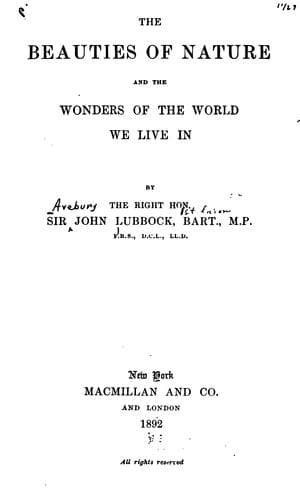
The Beauties of Nature, and the Wonders of the World We Live InLubbock, John, Sir
Philosophy
The Beauties of Nature, and the Wonders of the World We Live In
Lubbock, John, Sir
Astronomy; Natural history; Physical geography
"The most wonderful sight I remember," says Hamerton, "as an effect of
calm, was the inversion of Donati's Comet, in the year 1858, during the
nights when it was sufficiently near the horizon to approach the rugged
outline of Graiganunie, and be reflected beneath it in Loch Awe. In the
sky was an enormous aigrette of diamond fire, in the water a second
aigrette, scarcely less splendid, with its brilliant point directed
upwards, and its broad, shadowy extremity ending indefinitely in the
deep. To be out on the lake alone, in a tiny boat, and let it rest
motionless on the glassy water, with that incomparable spectacle before
one, was an experience to be remembered through a lifetime. I have seen
many a glorious sight since that now distant year, but nothing to equal
it in the association of solemnity with splendour."[70]
SHOOTING STARS
On almost any bright night, if we watch a short time some star will
suddenly seem to drop from its place, and, after a short plunge, to
disappear. This appearance is, however, partly illusory. While true
stars are immense bodies at an enormous distance, Shooting Stars are
very small, perhaps not larger than a paving stone, and are not visible
until they come within the limits of our atmosphere, by the friction
with which they are set on fire and dissipated. They are much more
numerous on some nights than others. From the 9th to the 11th August we
pass through one cluster which is known as the Perseids; and on the 13th
and 14th November a still greater group called by astronomers the
Leonids. The Leonids revolve round the Sun in a period of 33 years, and
in an elliptic orbit, one focus of which is about at the same distance
from the Sun as we are, the other at about that of Uranus. The shoal of
stars is enormous; its diameter cannot be less than 100,000 miles, and
its length many hundreds of thousands. There are, indeed, stragglers
scattered over the whole orbit, with some of which we come in contact
every year, but we pass through the main body three times in a
century--last in 1866--capturing millions on each occasion. One of these
has been graphically described by Humboldt:
Public-domain text, read in full here on John Shaqi.
Reviews
Reviews
No reviews yet
Be the first to share your thoughts on this work.
Elsewhere in the archive
Join the Discussion
Join the discussion
Sign in to leave a comment or review.
Sign InorCreate an account