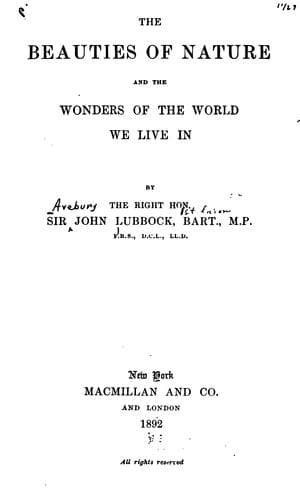
The Beauties of Nature, and the Wonders of the World We Live InLubbock, John, Sir
Philosophy
The Beauties of Nature, and the Wonders of the World We Live In
Lubbock, John, Sir
Astronomy; Natural history; Physical geography
THE STARS
We have been dealing in the earlier part of this chapter with figures
and distances so enormous that it is quite impossible for us to realise
them; and yet we have still others to consider compared with which even
the solar system is insignificant.
In the first place, the number of the Stars is enormous. When we look at
the sky at night they seem, indeed, almost innumerable; so that, like
the sands of the sea, the Stars of heaven have ever been used as
effective symbols of number. The total number visible to the naked eye
is, however, in reality only about 3000, while that shown by the
telescope is about 100,000,000. Photography, however, has revealed to us
the existence of others which no telescope can show. We cannot by
looking long at the heavens see more than at first; in fact, the first
glance is the keenest. In photography, on the contrary, no light which
falls on the plate, however faint, is lost; it is taken in and stored
up. In an hour the effect is 3600 times as great as in a second. By
exposing the photographic plate, therefore, for some hours, and even on
successive nights, the effect of the light is as it were accumulated,
and stars are rendered visible, the light of which is too feeble to be
shown by any telescope.
The distances and magnitudes of the Stars are as astonishing as their
numbers, Sirius, for instance, being about twenty times as heavy as the
Sun itself, 50 times as bright, and no less than 1,000,000 times as far
away; while, though like other stars it seems to us stationary, it is in
reality sweeping through the heavens at the rate of 1000 miles a minute;
Maia, Electra, and Alcyone, three of the Pleiades, are considered to be
respectively 400, 480, and 1000 times as brilliant as the Sun, Canopus
2500 times, and Arcturus, incredible as it may seem, even 8000 times, so
that, in fact, the Sun is by no means one of the largest Stars. Even the
minute Stars not separately visible to the naked eye, and the millions
which make up the Milky Way, are considered to be on an average fully
equal to the Sun in lustre.
Arcturus is, so far as we know at present, the swiftest, brightest, and
largest of all. Its speed is over 300 miles a second, it is said to be
8000 times as bright as the Sun, and 80 times as large, while its
distance is so great that its light takes 200 years in reaching us.
Public-domain text, read in full here on John Shaqi.
Reviews
Reviews
No reviews yet
Be the first to share your thoughts on this work.
Elsewhere in the archive
Join the Discussion
Join the discussion
Sign in to leave a comment or review.
Sign InorCreate an account