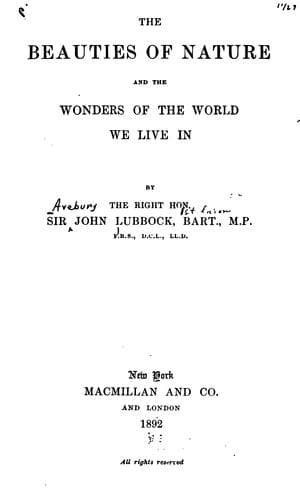
The Beauties of Nature, and the Wonders of the World We Live InLubbock, John, Sir
Philosophy
The Beauties of Nature, and the Wonders of the World We Live In
Lubbock, John, Sir
Astronomy; Natural history; Physical geography
This, however, by no means applies to all the nebulae. The spectrum of a
star is a bright band of colour crossed by dark lines; that of a gaseous
nebula consists of bright lines. This test has been made use of, and
indicates that some of the nebulae are really immense masses of
incandescent and very attenuated gas; very possibly, however, in a
condition of which we have no experience, and arranged in discs, bands,
rings, chains, wisps, knots, rays, curves, ovals, spirals, loops,
wreaths, fans, brushes, sprays, lace, waves, and clouds. Huggins has
shown that many of them are really stupendous masses of glowing gas,
especially of hydrogen, and perhaps of nitrogen, while the spectrum also
shows other lines which perhaps may indicate some of the elements which,
so far as our Earth is concerned, appear to be missing between hydrogen
and lithium. Many of the nebulae are exquisitely beautiful, and their
colour very varied.
In some cases, moreover, nebulae seem to be gradually condensing into
groups of stars, and in many cases it is difficult to say whether we
should consider a given group as a cluster of stars surrounded by
nebulous matter or a gaseous nebula condensed here and there into stars.
"Besides the single Sun," says Proctor, "the universe contains groups
and systems and streams of primary suns; there are galaxies of minor
orbs; there are clustering stellar aggregations showing every variety of
richness, of figure, and of distribution; there are all the various
forms of star cloudlets, resolvable and irresolvable, circular,
elliptical, and spiral; and lastly, there are irregular masses of
luminous gas clinging in fantastic convolutions around stars and star
systems. Nor is it unsafe to assert that other forms and varieties of
structure will yet be discovered, or that hundreds more exist which we
may never hope to recognise."
Nor is it only as regards the magnitude and distances of the heavenly
bodies that we are lost in amazement and admiration. The lapse of time
is a grander element in Astronomy even than in Geology, and dates back
long before Geology begins. We must figure to ourselves a time when the
solid matter which now composes our Earth was part of a continuous and
intensely heated gaseous body, which extended from the centre of the Sun
to beyond the orbit of Neptune, and had, therefore, a diameter of more
than 6,000,000,000 miles.
As this slowly contracted, Neptune was detached, first perhaps as a
ring, and then as a spherical body. Ages after this Uranus broke away.
Public-domain text, read in full here on John Shaqi.
Reviews
Reviews
No reviews yet
Be the first to share your thoughts on this work.
Elsewhere in the archive
Join the Discussion
Join the discussion
Sign in to leave a comment or review.
Sign InorCreate an account