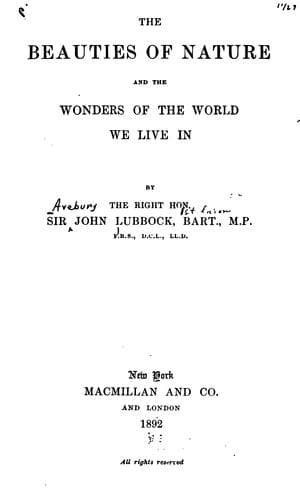
The Beauties of Nature, and the Wonders of the World We Live InLubbock, John, Sir
Philosophy
The Beauties of Nature, and the Wonders of the World We Live In
Lubbock, John, Sir
Astronomy; Natural history; Physical geography
The reckless and wanton destruction of forests has ruined some of the
richest countries on earth. Syria and Asia Minor, Palestine and the
north of Africa were once far more populous than they are at present.
They were once lands "flowing with milk and honey," according to the
picturesque language of the Bible, but are now in many places reduced to
dust and ashes. Why is there this melancholy change? Why have deserts
replaced cities? It is mainly owing to the ruthless destruction of the
trees, which has involved that of nations. Even nearer home a similar
process may be witnessed. Two French departments--the Hautes- and
Basses-Alpes--are being gradually reduced to ruin by the destruction of
the forests. Cultivation is diminishing, vineyards are being washed
away, the towns are threatened, the population is dwindling, and unless
something is done the country will be reduced to a desert; until, when
it has been released from the destructive presence of man, Nature
reproduces a covering of vegetable soil, restores the vegetation,
creates the forests anew, and once again fits these regions for the
habitation of man.
In another part of France we have an illustration of the opposite
process.
The region of the Landes, which fifty years ago was one of the poorest
and most miserable in France, has now been made one of the most
prosperous owing to the planting of Pines. The increased value is
estimated at no less than 1,000,000,000 francs. Where there were fifty
years ago only a few thousand poor and unhealthy shepherds whose flocks
pastured on the scanty herbage, there are now sawmills, charcoal kilns,
and turpentine works, interspersed with thriving villages and fertile
agricultural lands.
In our own country, though woodlands are perhaps on the increase, true
forest scenery is gradually disappearing. This is, I suppose,
unavoidable, but it is a matter of regret. Forests have so many charms
of their own. They give a delightful impression of space and of
abundance.
The extravagance is sublime. Trees, as Jefferies says, "throw away
handfuls of flower; and in the meadows the careless, spendthrift ways of
grass and flower and all things are not to be expressed. Seeds by the
hundred million float with absolute indifference on the air. The oak has
a hundred thousand more leaves than necessary, and never hides a single
acorn. Nothing utilitarian--everything on a scale of splendid waste.
Such noble, broadcast, open-armed waste is delicious to behold. Never
was there such a lying proverb as 'Enough is as good as a feast.' Give
me the feast; give me squandered millions of seeds, luxurious carpets of
petals, green mountains of oak-leaves. The greater the waste the greater
the enjoyment--the nearer the approach to real life."
Public-domain text, read in full here on John Shaqi.
Reviews
Reviews
No reviews yet
Be the first to share your thoughts on this work.
Join the Discussion
Join the discussion
Sign in to leave a comment or review.
Sign InorCreate an account