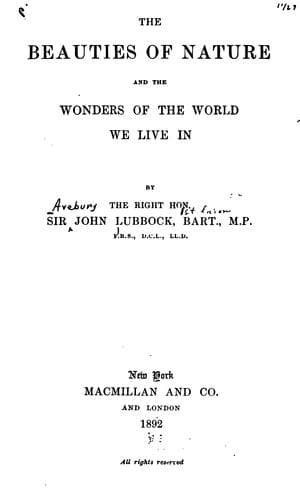
The Beauties of Nature, and the Wonders of the World We Live InLubbock, John, Sir
Philosophy
The Beauties of Nature, and the Wonders of the World We Live In
Lubbock, John, Sir
Astronomy; Natural history; Physical geography
It is of course impossible here to give any idea of the complexity of
structure of our forest trees. A slice across the stem of a tree shows
many different tissues with more or less technical names, bark and
cambium, medullary rays, pith, and more or less specialised tissue;
air-vessels, punctate vessels, woody fibres, liber fibres, scalariform
vessels, and other more or less specialised tissues.
Let us take a single leaf. The name is synonymous with anything very
thin, so that we might well fancy that a leaf would consist of only one
or two layers of cells. Far from it, the leaf is a highly complex
structure. On the upper surface are a certain number of scattered hairs,
while in the bud these are often numerous, long, silky, and serve to
protect the young leaf, but the greater number fall off soon after the
leaf expands. The hairs are seated on a layer of flattened cells--the
skin or epidermis. Below this are one or more layers of "palisade
cells," the function of which seems to be to regulate the quantity of
light entering the leaf. Under these again is the "parenchyme," several
layers of more or less rounded cells, leaving air spaces and passages
between them. From place to place in the parenchyme run "fibro-vascular
bundles," forming a sort of skeleton to the leaf, and comprising
air-vessels on the upper side, rayed or dotted vessels with woody fibre
below, and vessels of various kinds. The under surface of the leaf is
formed by another layer of flattened cells, supporting generally more or
less hairs, and some of them specially modified so as to leave minute
openings or "stomata" leading into the air passages. These stomata are
so small that there are millions on a single leaf, and on plants growing
in dry countries, such as the Evergreen Oak, Oleander, etc., they are
sunk in pits, and further protected by tufts of hair.
The cells of the leaf again are themselves complex. They consist of a
cell wall perforated by extremely minute orifices, of protoplasm, cell
fluid, and numerous granules of "Chlorophyll," which give the leaf its
green colour.
While these are, stated very briefly, the essential parts of a leaf, the
details differ in every species, while in the same species and even in
the same plant, the leaves present minor differences according to the
situation in which they grow.
Since, then, there is so much complex structure in a single leaf, what
must it be in a whole plant? There is a giant sea-weed (Macrocystis),
which has been known to reach a length of 1000 feet, as also do some of
the lianas of tropical forests. These, however, attain no great bulk,
and the most gigantic specimens of the vegetable kingdom yet known are
the Wellingtonia (Sequoia) gigantea, which grows to a height of 450
feet, and the Blue Gum (Eucalyptus) even to 480.
Public-domain text, read in full here on John Shaqi.
Reviews
Reviews
No reviews yet
Be the first to share your thoughts on this work.
Join the Discussion
Join the discussion
Sign in to leave a comment or review.
Sign InorCreate an account