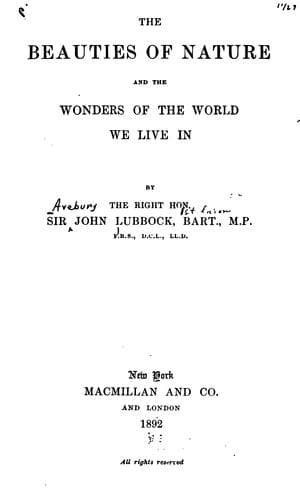
The Beauties of Nature, and the Wonders of the World We Live InLubbock, John, Sir
Philosophy
The Beauties of Nature, and the Wonders of the World We Live In
Lubbock, John, Sir
Astronomy; Natural history; Physical geography
One is apt to look on animal structure as more delicate, and of a higher
order, than that of plants. And so no doubt it is. Yet an animal, even
man himself, will recover from a wound or an operation more rapidly and
more perfectly than a tree.[32]
Trees again derive a special interest from the venerable age they
attain. In some cases, no doubt, the age is more or less mythical, as,
for instance, the Olive of Minerva at Athens, the Oaks mentioned by
Pliny, "which were thought coeval with the world itself," the Fig tree,
"under which the wolf suckled the founder of Rome and his brother,
lasting (as Tacitus calculated) 840 years, putting out new shoots, and
presaging the translation of that empire from the Caesarian line,
happening in Nero's reign."[33] But in other cases the estimates rest on
a surer foundation, and it cannot be doubted that there are trees still
living which were already of considerable size at the time of the
Conquest. The Soma Cypress of Lombardy, which is 120 feet high and 23 in
circumference, is calculated to go back to forty years before the birth
of Christ. Francis the First is said to have driven his sword into it in
despair after the battle of Padua, and Napoleon altered his road over
the Simplon so as to spare it.
Ferdinand and Isabella in 1476 swore to maintain the privileges of the
Biscayans under the old Oak of Guernica. In the Ardennes an Oak cut down
in 1824 contained a funeral urn and some Samnite coins. A writer at the
time drew the conclusion that it must have been already a large tree
when Rome was founded, and though the facts do not warrant this
conclusion, the tree did, no doubt, go back to Pagan times. The great
Yew of Fountains Abbey is said to have sheltered the monks when the
abbey was rebuilt in 1133, and is estimated at an age of 1300 years;
that at Brabourne in Kent at 3000. De Candolle gives the following as
the ages attainable:--
The Ivy 450 years
Larch 570 "
Plane 750 "
Cedar of Lebanon 800 "
Lime 1100 "
Oak 1500 "
Taxodium distichum 4000 to 6000
Baobab 6000 years
Nowhere is woodland scenery more beautiful than where it passes
gradually into the open country. The separate trees, having more room
both for their roots and branches, are finer, and can be better seen,
while, when they are close together, "one cannot see the wood for the
trees." The vistas which open out are full of mystery and of promise,
and tempt us gradually out into the green fields.
What pleasant memories these very words recall, games in the hay as
children, and sunny summer days throughout life.
Public-domain text, read in full here on John Shaqi.
Reviews
Reviews
No reviews yet
Be the first to share your thoughts on this work.
Join the Discussion
Join the discussion
Sign in to leave a comment or review.
Sign InorCreate an account