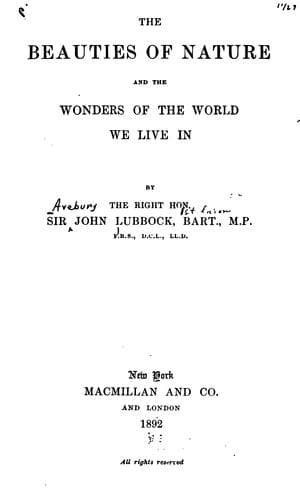
The Beauties of Nature, and the Wonders of the World We Live InLubbock, John, Sir
Philosophy
The Beauties of Nature, and the Wonders of the World We Live In
Lubbock, John, Sir
Astronomy; Natural history; Physical geography
"Is it not probable that this action of finely-divided matter may have
some influence on the colour of some of the Swiss lakes--as that of
Geneva for example? This lake is simply an expansion of the river Rhone,
which rushes from the end of the Rhone glacier, as the Arveiron does
from the end of the Mer de Glace. Numerous other streams join the Rhone
right and left during its downward course; and these feeders, being
almost wholly derived from glaciers, join the Rhone charged with the
finer matter which these in their motion have ground from the rocks over
which they have passed. But the glaciers must grind the mass beneath
them to particles of all sizes, and I cannot help thinking that the
finest of them must remain suspended in the lake throughout its entire
length. Faraday has shown that a precipitate of gold may require months
to sink to the bottom of a bottle not more than five inches high, and in
all probability it would require ages of calm subsidence to bring all
the particles which the Lake of Geneva contains to its bottom. It seems
certainly worthy of examination whether such particles suspended in the
water contribute to the production of that magnificent blue which has
excited the admiration of all who have seen it under favourable
circumstances."[46]
Among the Swiss mountains themselves each has its special character.
Tyndall thus describes a view in the Alps, certainly one of the most
beautiful--that, namely, from the summit of the AEgischhorn.
"Skies and summits are to-day without a cloud, and no mist or turbidity
interferes with the sharpness of the outlines. Jungfrau, Monk, Eiger,
Trugberg, cliffy Strahlgrat, stately lady-like Aletschhorn, all grandly
pierce the empyrean. Like a Saul of Mountains, the Finsteraarhorn
overtops all his neighbours; then we have the Oberaarhorn, with the
riven glacier of Viesch rolling from his shoulders. Below is the
Marjelin See, with its crystal precipices and its floating icebergs,
snowy white, sailing on a blue green sea. Beyond is the range which
divides the Valais from Italy. Sweeping round, the vision meets an
aggregate of peaks which look as fledglings to their mother towards the
mighty Dom. Then come the repellent crags of Mont Cervin; the ideal of
moral savagery, of wild untameable ferocity, mingling involuntarily with
our contemplation of the gloomy pile. Next comes an object, scarcely
less grand, conveying, it may be, even a deeper impression of majesty
and might than the Matterhorn itself--the Weisshorn, perhaps the most
splendid object in the Alps. But beauty is associated with its force,
and we think of it, not as cruel, but as grand and strong. Further to
the right the great Combin lifts up his bare head; other peaks crowd
around him; while at the extremity of the curve round which our gaze has
swept rises the sovran crown of Mont Blanc. And now, as day sinks,
scrolls of pearly clouds draw themselves around the mountain crests,
being wafted from them into the distant air.
Public-domain text, read in full here on John Shaqi.
Reviews
Reviews
No reviews yet
Be the first to share your thoughts on this work.
Elsewhere in the archive
Join the Discussion
Join the discussion
Sign in to leave a comment or review.
Sign InorCreate an account