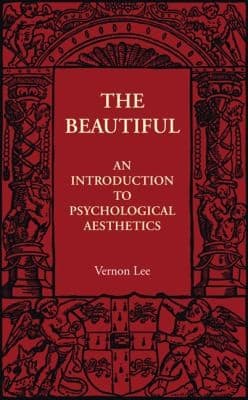
The Beautiful: An Introduction to Psychological AestheticsLee, Vernon
Philosophy
The Beautiful: An Introduction to Psychological Aesthetics
Lee, Vernon
Aesthetics; Form (Aesthetics); Psychology, Applied
The _practical_ question about a shape is therefore: Does it warrant
the inference of a _thing_ able to change its position in
three-dimensional space? to advance or recede from us? And if so in
what manner? Will it, like a loose stone, fall upon us? like flame, rise
towards us? like water, spread over us? Or will it change its place
only if _we_ supply the necessary _locomotion?_ Briefly: is the
thing of which we see the shape inert or active? And if this shape
belongs to a thing possessing activity of its own, is its locomotion of
that slow regular kind we call the growth and spreading of plants?
Or of the sudden, wilful kind we know in animals and men? What
does this shape tell us of such more formidable locomotion? Are
these details of curve and colour to be interpreted into jointed limbs,
can the _thing_ fling out laterally, run after us, can it catch and
swallow us? Or is it such that _we_ can do thus by it? Does this
shape suggest the thing's possession of desires and purposes which
we can deal with? And if so, _why is it where it is?_ Whence does it
come? What is it going to do? What is it _thinking_ of (if it can
think)? How will it _feel_ towards us (if it can feel)? What would it
say (if it could speak)? What will be its future and what may have
been its past? To sum all up: What does the presence of this shape
lead us to think and do and feel?
Such are a few of the thoughts started by that shape and the
possibility of its belonging to a thing. And even when, as we shall
sometimes find, they continually return back to the shape and play
round and round it in centrifugal and centripetal alternations, yet all
these thoughts are excursions, however brief, from the world of
definite unchanging shapes into that of various and ever varying
things; interruptions, even if (as we shall later see) intensifying
interruptions, of that concentrated and coordinated contemplation of
shapes, with which we have hitherto dealt. And these excursions,
and a great many more, from the world of shapes into that of things,
are what we shall deal with, when we come to Art, under the
heading of _representation_ and _suggestion,_ or, as is usually said,
of _subject_ and _expression_ as opposed to _form._
CHAPTER XIII
FROM THE THING TO THE SHAPE
THE necessities of analysis and exposition have led us from the
Shape to the Thing, from aesthetic contemplation to discursive and
practical thinking. But, as the foregoing chapter itself suggests, the
real order of precedence, both for the individual and the race, is
inevitably the reverse, since without a primary and dominant interest
in things no creatures would have survived to develop an interest in
shapes.
Public-domain text, read in full here on John Shaqi.
Reviews
Reviews
No reviews yet
Be the first to share your thoughts on this work.
Elsewhere in the archive
Join the Discussion
Join the discussion
Sign in to leave a comment or review.
Sign InorCreate an account