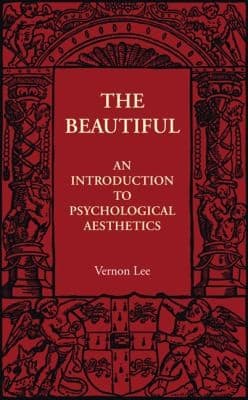
The Beautiful: An Introduction to Psychological AestheticsLee, Vernon
Philosophy
The Beautiful: An Introduction to Psychological Aesthetics
Lee, Vernon
Aesthetics; Form (Aesthetics); Psychology, Applied
Indeed, considering the imperative need for an ever abbreviated and
often automatic system of human reactions to sense data, it is by no
means easy to understand (and the problem has therefore been
utterly neglected) how mankind ever came to evolve any process as
lengthy and complicated as that form-contemplation upon which all
aesthetic preference depends. I will hazard the suggestion that
familiarity with shapes took its original evolutional utility, as well as
its origin, from the dangers of over rapid and uncritical inference
concerning the qualities of things and man's proper reactions
towards them. It was necessary, no doubt, that the roughest
suggestion of a bear's growl and a bear's outline should send our
earliest ancestors into their sheltering caves. But the occasional
discovery that the bear was not a bear but some more harmless
and edible animal must have brought about a comparison, a
discrimination between the visible aspects of the two beasts, and a
mental storage of their difference in shape, gait and colour.
Similarly the deluding resemblance between poisonous and
nutritious fruits and roots, would result, as the resemblance between
the nurse's finger and nipple results with the infant, in attention to
visible details, until the acquisition of vivid mental images became
the chief item of the savage man's education, as it still is of the
self-education of the modern child. This evolution of interest in visible
aspects would of course increase tenfold as soon as mankind took to
making things whose usefulness (_i.e._ their still non-existent
qualities) might be jeopardised by a mistake concerning their shape.
For long after _over_ and _under, straight_ and _oblique, right_ and
_left,_ had become habitual perceptions in dealing with food and
fuel, the effective aim of a stone, the satisfactory flight of an arrow,
would be discovered to depend upon more or less of what we call
horizontals and perpendiculars, curves and angles; and the stability
of a fibrous tissue upon the intervals of crossing and recrossing, the
rythmical or symmetrical arrangements revealed by the hand or eye.
In short, _making,_ being inevitably _shaping,_ would have
developed a more and more accurate perception and recollection of
every detail of shape. And not only would there arise a comparison
between one shape and another shape, but between the shape
actually under one's eyes and the shape no longer present, between
the shape as it really was and the shape as it ought to be. Thus in the
very course of practical making of things there would come to be
little interludes, recognised as useful, first of more and more
careful looking and comparing, and then of real contemplation:
contemplation of the arrow-head you were chipping, of the mat
you were weaving, of the pot you were rubbing into shape;
contemplation also of the _other_ arrow-head or mat or pot existing
only in your wishes; of the shape you were trying to obtain with a
Public-domain text, read in full here on John Shaqi.
Reviews
Reviews
No reviews yet
Be the first to share your thoughts on this work.
Elsewhere in the archive
Join the Discussion
Join the discussion
Sign in to leave a comment or review.
Sign InorCreate an account