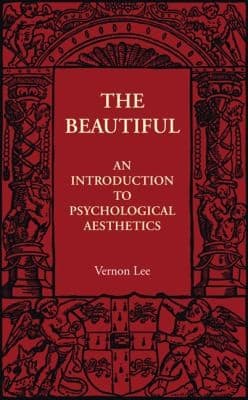
The Beautiful: An Introduction to Psychological AestheticsLee, Vernon
Philosophy
The Beautiful: An Introduction to Psychological Aesthetics
Lee, Vernon
Aesthetics; Form (Aesthetics); Psychology, Applied
I therefore commend to the Reader the now somewhat unfashionable
hypothesis of Semper and his school, according to which the first
preference for beauty of shape must be sought for in those arts
like stone and metal work, pottery and weaving, which give
opportunities for repetition, reduplication, hence rythm and
symmetry, and whose material and technique produce what are
called geometric patterns, meaning such as exist in two dimensions
and do not imitate the shapes of real objects. This theory has been
discredited by the discovery that very primitive and savage mankind
possessed a kind of art of totally different nature, and which analogy
with that of children suggests as earlier than that of pattern: the art
which the ingenious hypothesis of Mr Henry Balfour derives from
recognition of accidental resemblances between the shapes and
stains of wood or stone and such creatures and objects as happen to
be uppermost in the mind of the observer, who cuts or paints
whatever may be needed to complete the likeness and enable others
to perceive the suggestion. Whether or not this was its origin, there
seems to have existed in earliest times such an art of a strictly
representative kind, serving (like the spontaneous art of children) to
evoke the idea of whatever was interesting to the craftsman and his
clients, and doubtless practically to have some desirable magic
effect upon the realities of things. But (to return to the hypothesis of
the aesthetic primacy of geometric and non-representative art) it is
certain that although such early representations occasionally attain
marvellous life-likeness and anatomical correctness, yet they do not
at first show any corresponding care for symmetrical and rythmical
arrangement. The bisons and wild boars, for instance, of the
Altamira cave frescoes, do indeed display vigour and beauty in the
lines constituting them, proving that successful dealing with shape,
even if appealing only to practical interest, inevitably calls forth the
empathic imagination of the more gifted artists; but these
marvellously drawn figures are all huddled together or scattered as
out of a rag-bag; and, what is still more significant, they lack that
insistence on the feet which not only suggests ground beneath them
but, in so doing, furnishes a horizontal by which to start, measure
and take the bearings of all other lines. These astonishing
palaeolithic artists (and indeed the very earliest Egyptian and Greek
ones) seem to have thought only of the living models and their
present and future movements, and to have cared as little for lines
and angles as the modern children whose drawings have been
instructively compared with theirs by Levinstein and others. I
therefore venture to suggest that such aesthetically essential
attention to direction and composition must have been applied to
representative art when its realistic figures were gradually
incorporated into the patterns of the weaver and the potter. Such
Public-domain text, read in full here on John Shaqi.
Reviews
Reviews
No reviews yet
Be the first to share your thoughts on this work.
Elsewhere in the archive
Join the Discussion
Join the discussion
Sign in to leave a comment or review.
Sign InorCreate an account