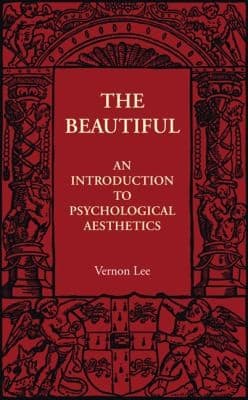
The Beautiful: An Introduction to Psychological AestheticsLee, Vernon
Philosophy
The Beautiful: An Introduction to Psychological Aesthetics
Lee, Vernon
Aesthetics; Form (Aesthetics); Psychology, Applied
premonitory emotion of the effect which its peculiarities would
produce when once made visible to your eye! For the man cutting
the arrow-head, the woman plaiting the mat, becoming familiar with
the appropriate shapes of each and thinking of the various individual
arrow-heads or mats of the same type, _would become aware of the
different effect which such shapes had on the person who looked at
them._ Some of these shapes would be so dull, increasing the
tediousness of chipping and filing or of laying strand over strand;
others so alert, entertaining and likeable, as if they were helping in
the work; others, although equally compatible with utility, fussing or
distressing one, never doing what one expected their lines and
curves to do. To these suppositions I would add a few more
suggestions regarding the evolution of shape-contemplation out of
man's perfunctory and semi-automatic seeing of "Things." The
handicraftsman, armourer, weaver, or potter, benefits by his own
and his forerunners' practical experience of which shape is the more
adapted for use and wear, and which way to set about producing it;
his technical skill becomes half automatic, so that his eye and mind,
acting as mere overseers to his muscles, have plenty of time for
contemplation so long as everything goes right and no new moves
have to be made. And once the handicraftsman contemplates the
shape as it issues from his fingers, his mind will be gripped by that
liking or disliking expressed by the words "beautiful" and "ugly."
Neither is this all. The owner of a weapon or a vessel or piece of
tissue, is not always intent upon employing it; in proportion to its
usefulness and durability and to the amount of time, good luck, skill
or strength required to make or to obtain it, this chattel will turn
from a slave into a comrade. It is furbished or mended, displayed to
others, boasted over, perhaps sung over as Alan Breck sang over his
sword. The owner's eye (and not less that of the man envious of the
owner!) caresses its shape; and its shape, all its well-known
ins-and-outs and ups-and-downs, haunts the memory, ready to start into
vividness whenever similar objects come under comparison. Now
what holds good of primaeval and savage man holds good also of
civilized, perhaps even of ourselves among our machine made and
easily replaced properties. The shape of the things we make and use
offers itself for contemplation in those interludes of inattention
which are half of the rythm of all healthful work. And it is this
normal rythm of attention swinging from effort to ease, which
explains how art has come to be a part of life, how mere aspects
have acquired for our feelings an importance rivalling that of things.
Public-domain text, read in full here on John Shaqi.
Reviews
Reviews
No reviews yet
Be the first to share your thoughts on this work.
Elsewhere in the archive
Join the Discussion
Join the discussion
Sign in to leave a comment or review.
Sign InorCreate an account