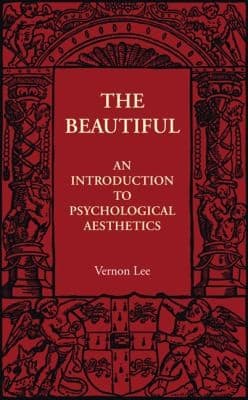
The Beautiful: An Introduction to Psychological AestheticsLee, Vernon
Philosophy
The Beautiful: An Introduction to Psychological Aesthetics
Lee, Vernon
Aesthetics; Form (Aesthetics); Psychology, Applied
How the aesthetic imperative, i.e. the necessities of satisfactory
shape-contemplation, qualifies and deflects the pursuit of such
non-aesthetic aims of art can be shown by comparing, for instance, the
mere audible devices for conveying conventional meaning and
producing and keeping up emotional conditions, viz. the hootings
and screechings of modern industrialism no less than the ritual
noises of savages, with the arrangements of well constituted pitch,
rythm, tonality and harmony in which military, religious or dance
music has disguised its non-aesthetic functions of conveying signals
or acting on the nerves. Whatever is unnecessary for either of these
motives (or any others) for making a noise, can be put to the account
of the desire to avoid ugliness and enjoy beauty. But the workings of
the aesthetic imperative can best be studied in the Art of the
visual-representative group, and especially in painting, which allows us to
follow the interplay of the desire to be told (or tell) _facts about
things_ with the desire to _contemplate shapes,_ and to contemplate
them (otherwise we should _not_ contemplate!) with sensuous,
intellectual and empathic satisfaction.
This brings us back to the Third Dimension, of which the possession
is, as have we seen, the chief difference between _Things,_ which
can alter their aspect in the course of their own and our actions, and
_Shapes,_ which can only be contemplated by our bodily and mental
eye, and neither altered nor thought of as altered without more or
less jeopardising their identity.
I daresay the Reader may not have been satisfied with the reference
to the locomotor nature of cubic perception as sufficient justification
of my thus connecting cubic existence with Things rather than with
Shapes, and my implying that aesthetic preference, due to the
sensory, intellectual and empathic factors of perception, is
applicable only to the two other dimensions. And the Reader's
incredulity and surprise will have been all the greater, because
recent art-criticism has sedulously inculcated that the suggestion of
cubic existence is the chief function of pictorial genius, and the
realisation of such cubic existence the highest delight which pictures
can afford to their worthy beholder. This particular notion, entirely
opposed to the facts of visual perception and visual empathy, will
repay discussion, inasmuch as it accidentally affords an easy
entrance into a subject which has hitherto presented inextricable
confusion, namely the relations of _Form_ and _Subject,_ or, as I
have accustomed the Reader to consider them, the _contemplated
Shape_ and the _thought-of Thing._
Public-domain text, read in full here on John Shaqi.
Reviews
Reviews
No reviews yet
Be the first to share your thoughts on this work.
Elsewhere in the archive
Join the Discussion
Join the discussion
Sign in to leave a comment or review.
Sign InorCreate an account