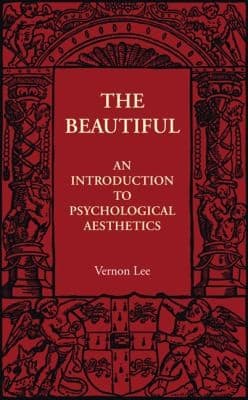
The Beautiful: An Introduction to Psychological AestheticsLee, Vernon
Philosophy
The Beautiful: An Introduction to Psychological Aesthetics
Lee, Vernon
Aesthetics; Form (Aesthetics); Psychology, Applied
felt by the attentive beholder, but not habitually analysed or set forth
in words. Moreover the creation of two-dimensional shapes
satisfying to contemplation depends upon two very different factors:
on traditional experience with regard to the more general
arrangements of lines, and on individual energy and sensitiveness,
i.e. on genius in carrying out, and ringing changes on, such
traditional arrangements. And the possession of tradition or genius,
although no doubt the most important advantage of an artist,
happens not to be one to which he can apply himself as to a problem.
On the other hand a problem to be solved is eternally being pressed
upon every artist; pressed on him by his clients, by the fashion of his
time and also by his own self inasmuch as he is a man interested not
only in _shapes_ but in _things._ And thus we are back at the fact
that the problem given to the painter to solve by means of lines and
colours on a flat surface, is the problem of telling us something new
or something important about _things:_ what things are made of,
how they will react to our doings, how they move, what they feel
and think; and above all, I repeat it, what amount of space they
occupy with reference to the space similarly occupied, in present or
future, by other things including ourselves.
Our enquiry into the excessive importance attributed by critics to
pictorial suggestion of cubic existence has thus led us back to the
conclusion contained in previous chapters, namely that beauty
depending negatively on ease of visual perception, and positively
upon emphatic corroboration of our dynamic habits, is a quality of
_aspects,_ independent of cubic existence and every other possible
quality of _things_; except in so far as the thought of
three-dimensional, and other, qualities of things may interfere with the
freedom and readiness of mind requisite for such highly active and
sensitive processes as those of empathic form interpretation. But the
following chapter will, I trust, make it clear that such interference of
the _Thought about Things_ with the _Contemplation of Shapes_ is
essential to the rythm of our mental life, and therefore a chief factor
in all artistic production and appreciation.
CHAPTER XV
ATTENTION TO SHAPES
Public-domain text, read in full here on John Shaqi.
Reviews
Reviews
No reviews yet
Be the first to share your thoughts on this work.
Elsewhere in the archive
Join the Discussion
Join the discussion
Sign in to leave a comment or review.
Sign InorCreate an account