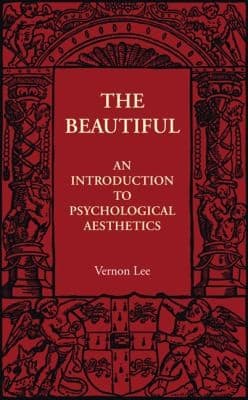
The Beautiful: An Introduction to Psychological AestheticsLee, Vernon
Philosophy
The Beautiful: An Introduction to Psychological Aesthetics
Lee, Vernon
Aesthetics; Form (Aesthetics); Psychology, Applied
This example of Michelangelo's ceiling shows how, thanks to the
rythmical nature of perception, art fulfils the mission of making us
think from Shapes to Things and from Things back to Shapes. And it
allows us to see the workings of that psychological law, already
manifest in the elementary relations of line to line and dot to dot, by
which whatever can be thought and felt in continuous alternation
tends to be turned into a whole by such reiteration of common
activities. And this means that Art adds to its processes of selection
and exclusion a process of _inclusion,_ safeguarding aesthetic
contemplation by drawing whatever is not wholly refractory into
that contemplation's orbit. This turning of non-aesthetic interests
from possible competitors and invaders into co-operating allies is an
incomparable multiplying factor of aesthetic satisfaction, enlarging
the sphere of aesthetic emotion and increasing that emotion's volume
and stability by inclusion of just those elements which would have
competed to diminish them. The typical instance of such a possible
competitor turned into an ally, is that of the cubic element, which I
have described (p. 85) as the first and most constant intruder from
the thought of _Things_ into the contemplation of _Shapes._ For the
introduction into a picture of a suggested third dimension is what
prevents our _thinking away from_ a merely two-dimensional aspect
by supplying subsidiary imaginary aspects susceptible of being
co-ordinated to it. So perspective and modelling in light and shade
satisfy our habit of locomotion by allowing us, as the phrase is, _to
go into_ a picture; and _going into,_ we remain there and establish
on its imaginary planes schemes of horizontals and verticals besides
those already existing on the real two-dimensional surface. This
addition of shapes due to perspective increases the already existing
dramas of empathy, instead of interrupting them by our looking
away from the picture, which we should infallibly do if our
exploring and so to speak _cubic-locomotor_ tendencies were not
thus employed inside the picture's limits.
Public-domain text, read in full here on John Shaqi.
Reviews
Reviews
No reviews yet
Be the first to share your thoughts on this work.
Elsewhere in the archive
Join the Discussion
Join the discussion
Sign in to leave a comment or review.
Sign InorCreate an account