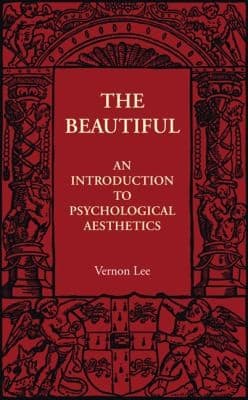
The Beautiful: An Introduction to Psychological AestheticsLee, Vernon
Philosophy
The Beautiful: An Introduction to Psychological Aesthetics
Lee, Vernon
Aesthetics; Form (Aesthetics); Psychology, Applied
THE storage and transfer of aesthetic emotion explain yet another
fact, with which indeed I began this little book: namely that the
word _Beautiful_ has been extended from whatever is satisfactory in
our contemplation of shapes, to a great number of cases where there
can be no question of shapes at all, as in speaking of a "beautiful
character" and a "fine moral attitude"; or else, as in the case of a
"beautiful bit of machinery," a "fine scientific demonstration" or a
"splendid surgical operation" where the shapes involved are not at
all such as to afford contemplative satisfaction. In such cases the
word _Beautiful_ has been brought over with the emotion of
satisfied contemplation. And could we examine microscopically the
minds of those who are thus applying it, we might perhaps detect,
round the fully-focussed thought of that admirable but nowise
_shapely_ thing or person or proceeding, the shadowy traces of
half-forgotten shapes, visible or audible, forming a halo of real aesthetic
experience, and evoked by that word _Beautiful_ whose application
they partially justify. Nor is this all. Recent psychology teaches that,
odd as it at first appears, our more or less definite images, auditive
as well as visual, and whether actually perceived or merely
remembered, are in reality the intermittent part of the mind's
contents, coming and going and weaving themselves on to a
constant woof of our own activities and feelings. It is precisely such
activities and feelings which are mainly in question when we apply
the words _Beautiful_ and _Ugly._ Thus everything which has come
in connexion with occasions for satisfactory shape-contemplation,
will meet with somewhat of the same reception as that shape-contemplation
originally elicited. And even the merest items of information which
the painter conveys concerning the visible universe; the merest
detail of human character conveyed by the poet; nay even the
mere nervous intoxication furnished by the musician, will all be
irradiated by the emotion due to the shapes they have been conveyed
in, and will therefore be felt as beautiful.
Moreover, as the "beautiful character" and "splendid operation" have
taught us, rare and desirable qualities are apt to be contemplated in a
"platonic" way. And even objects of bodily desire, so long as that
desire is not acute and pressing, may give rise to merely
contemplative longings. All this, added to what has previously been
said, sufficiently explains the many and heterogeneous items which
are irradiated by the word _Beautiful_ and the emotion originally
arising from the satisfied contemplation of mere shapes.
Public-domain text, read in full here on John Shaqi.
Reviews
Reviews
No reviews yet
Be the first to share your thoughts on this work.
Elsewhere in the archive
Join the Discussion
Join the discussion
Sign in to leave a comment or review.
Sign InorCreate an account