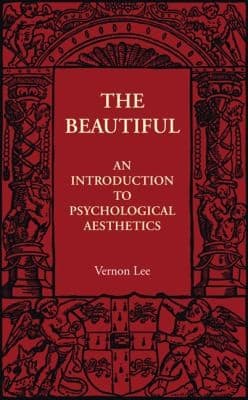
The Beautiful: An Introduction to Psychological AestheticsLee, Vernon
Philosophy
The Beautiful: An Introduction to Psychological Aesthetics
Lee, Vernon
Aesthetics; Form (Aesthetics); Psychology, Applied
For art-evolutional questions consult:
IX. _Haddon._ Evolution in Art, 1895.
X. _Yrjö Hirn._ Origins of Art, Macmillan, 1900.
XI. _Levinstein._ Kinderzeichnungen, Leipzig, 1905.
XII. _Loewy._ Nature in early Greek Art (translation), Duckworth,
1907.
XIII. _Delia Seta._ Religione e Arte Figurata, Rome, 1912.
XIV. _Spearing._ The Childhood of Art, 1913.
XV. _Jane Harrison._ Ancient Art and Ritual, 1913.
INDEX
Aesthetic:
aridity, 136-7;
imperative, 99-100;
irradiation, 147-52;
purification, 149-52;
responsiveness, active nature of, 128-36;
habit and familiarity affecting, 134-6
Altamira cave frescoes, 95
Art:
differential characteristic of, 116-18;
non-aesthetic aims of, 99-100, 137-8; utility of, 153-5
Aspect:
aesthetics concerned with, 15, 21, 105;
shape the determining feature of, 26-8
Attention, a factor distinguishing perception from sensation, 32
Balfour, H., 95
Beautiful:
aesthetic irradiation proceeding from use of adjective, 147-8;
attitude implied by use of adjective, 2-7, 18-19;
empathy the chief factor of preference, 67-8;
implies desire for reiterated perception, 53-4
Botticelli, 83
Brahms' _German Requiem,_ 150
Browning's _Abt Vogler,_ 141
Coleridge's _Ode to Dejection,_ 131
Colour, passive reception of, 23-4, 29
Contemplative satisfaction marking aesthetic attitude, 8-15
Correggio's _Danae,_ 151
Cubic Existence:
perception of, 85;
pictorial suggestion of, importance attached to, discussed, 101-5
_Discobolus,_ 115
Einfühlung, 59;
misinterpretations of, 66-7
Emotion, storage and transfer of, 139-46
Empathy, 61-69;
complexity of movements of lines, 78-83;
movements of lines, 70-77;
second element of shape-perception, 59-60
Extension existing in perception, 35-8
Fechner, 130
Hildebrand, 102, 118
Inner Mimicry, 74-5
James, W., 153
Keats' _Grecian Urn,_ 77
Levinstein, 96
Lipps, 66
Locomotion of Things, distinction between, and empathic
movement of lines, 111-16
Lotze, 66
Mantegna, 82
Memory:
a factor distinguishing perception from sensation, 32;
in perception, 40-1
Michel Angelo, 114, 122
Movement of Lines, distinction between, and locomotion of Things,
111-16; _see also_ Empathy
Object of Perception, subject's activities merged in, 57, 58
Perception:
active process involved in, 29-34, 128-9;
distinguished from sensation, 32;
subject and object of, 55-60
Raphael's _Heliodorus,_ 119
Relaxation an element of form-perception, 42
Rembrandt, 122
Rythm, 42-5
Public-domain text, read in full here on John Shaqi.
Reviews
Reviews
No reviews yet
Be the first to share your thoughts on this work.
Elsewhere in the archive
Join the Discussion
Join the discussion
Sign in to leave a comment or review.
Sign InorCreate an account