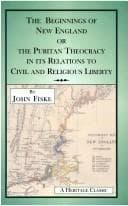
The Beginnings of New England: Or the Puritan Theocracy in its Relations to Civil and Religious LibertyFiske, John
History
The Beginnings of New England: Or the Puritan Theocracy in its Relations to Civil and Religious Liberty
Fiske, John
New England -- History -- Colonial period, ca. 1600-1775; Puritans
The general sentiment of the early New England writers was like that
of the "Wonder-working Providence," though it did not always find such
rhapsodic expression. It has left its impress upon the minds of their
children's children down to our own time, and has affected the opinions
held about them by other people. It has had something to do with a
certain tacit assumption of superiority on the part of New Englanders,
upon which the men and women of other communities have been heard
to comment in resentful and carping tones. There has probably never
existed, in any age or at any spot on the earth's surface, a group of
people that did not take for granted its own preeminent excellence. Upon
some such assumption, as upon an incontrovertible axiom, all historical
narratives, from the chronicles of a parish to the annals of an empire,
alike proceed. But in New England it assumed a form especially apt to
provoke challenge. One of its unintentional effects was the setting up
of an unreal and impossible standard by which to judge the acts and
motives of the Puritans of the seventeenth century. We come upon
instances of harshness and cruelty, of narrow-minded bigotry, and
superstitious frenzy; and feel, perhaps, a little surprised that
these men had so much in common with their contemporaries. Hence the
interminable discussion which has been called forth by the history of
the Puritans, in which the conclusions of the writer have generally been
determined by circumstances of birth or creed, or perhaps of reaction
against creed. One critic points to the Boston of 1659 or the Salem of
1692 with such gleeful satisfaction as used to stir the heart of Thomas
Paine when he alighted upon an inconsistency in some text of the Bible;
while another, in the firm conviction that Puritans could do no wrong,
plays fast and loose with arguments that might be made to justify the
deeds of a Torquemada. [Sidenote: Acts of the Puritans often judged by a
wrong standard]
Public-domain text, read in full here on John Shaqi.
Reviews
Reviews
No reviews yet
Be the first to share your thoughts on this work.
Elsewhere in the archive
Join the Discussion
Join the discussion
Sign in to leave a comment or review.
Sign InorCreate an account