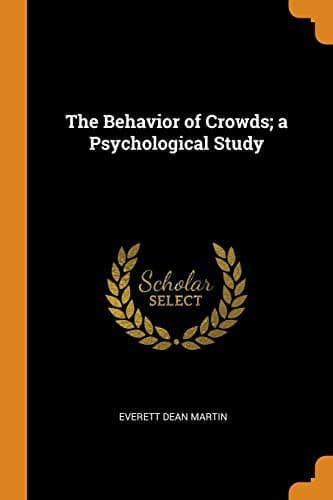
The Behavior of Crowds: A Psychological StudyMartin, Everett Dean
Science
The Behavior of Crowds: A Psychological Study
Martin, Everett Dean
Crowds
Nearly everyone in America can read, for the "schoolhouse is the bulwark
of democratic freedom." However, with the decrease in illiteracy there
has gone a corresponding lowering of literary and intellectual
standards, a growing timidity in telling the truth, and a passion for
the sensationally commonplace. If it be true that before people may be
politically free they must be free to function mentally, one wonders how
much of an aid to liberty the public schools in this country have been,
or if, with their colossal impersonal systems and stereotyped methods of
instruction, they have not rather on the whole succeeded chiefly in
making learning uninteresting, dulling curiosity and killing habits of
independent thinking. There is probably no public institution where the
spirit of the crowd reigns to the extent that it does in the public
school. The aim seems to be to mold the child to type, make him the
good, plodding citizen, teaching him only so much as some one thinks it
is to the public's interest that he should know. I am sure that everyone
who is familiar with the actions of the school authorities in New York
City during the two years, 1918 and 1919, will be impelled to look
elsewhere for much of that liberty which is supposed to go with
democracy.
Some years ago I conducted a little investigation into the mental habits
of the average high-school graduate. An examination was made of twenty
or more young people who had been out of school one year. This is
doubtless too limited a number to give the findings great general
significance, but I give the results in brief for what they are worth.
These students had been in school for eleven years. I thought that they
ought at least to have a minimum of general cultural information and to
be able to express some sort of opinion about the commonplaces of our
spiritual heritage. The questions asked were such as follow: What is the
difference between the Declaration of Independence and the Constitution
of the United States? What is a dicotyledon? Does the name Darwin mean
anything to you? Have you ever heard of William James? What is the
significance of the battle of Tours? Who was Thomas Jefferson? There
were twenty questions in all. The average grade, even with the most
liberal marking, was 44.6. The general average was raised by one pupil
who made a grade of 69. But then we should not be too severe upon the
public-school graduate. One of the brightest college graduates I know
left a large Eastern institution believing that Karl Marx was a
philologist. Another, a graduate from a Western college, thought that
Venus de Milo was an Italian count who had been born without any arms. I
know a prominent physician, whose scientific training is such that he
has been a lecturer in a medical college, who believes that Heaven is
located just a few miles up in the sky, beyond the Milky Way. These are
doubtless exceptional cases, but how many persons with university
Public-domain text, read in full here on John Shaqi.
Reviews
Reviews
No reviews yet
Be the first to share your thoughts on this work.
Elsewhere in the archive
Join the Discussion
Join the discussion
Sign in to leave a comment or review.
Sign InorCreate an account