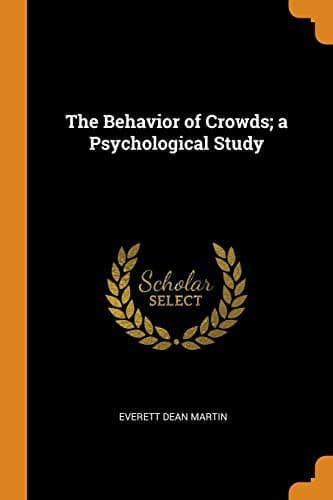
The Behavior of Crowds: A Psychological StudyMartin, Everett Dean
Science
The Behavior of Crowds: A Psychological Study
Martin, Everett Dean
Crowds
In the foregoing chapter, reference was made to our traditional
educational systems. The subject is so closely related to the mental
habits of democracy that it would be difficult to overemphasize its
importance for our study. Traditional educational methods have more
often given encouragement to crowd-thinking than to independence of
judgment. Thinking has been divorced from doing. Knowledge, instead of
being regarded as the foresight of ends to be reached and the conscious
direction of activity toward such ends, has been more commonly regarded
as the copying of isolated things to be learned. The act of learning has
been treated as if it were the passive reception of information imposed
from without. The subject to be learned has been sequestered and set
apart from experience as a whole, with the result that ideas easily
come to be regarded as things in themselves. Systems of thought are
built up with little or no sense of their connection with everyday
problems. Thus our present-day education prepares in advance both the
ready-made logical systems in which the crowd-mind takes refuge from the
concretely real and the disposition to accept truth second-hand, upon
the authority of another, which in the crowd-man becomes the spirit of
conformity.
Even science, taught in this spirit may be destructive of intellectual
freedom. Professor Dewey says that while science has done much to modify
men's thoughts, still
It must be admitted that to a considerable extent the progress
thus procured has been only technical; it has provided more
efficient means for satisfying pre-existent desires rather than
modified the quality of human purposes. There is, for example,
no modern civilization which is the equal of Greek culture in
all respects. Science is still too recent to have been absorbed
into imaginative and emotional disposition. Men move more
swiftly and surely to the realization of their ends, but their
ends too largely remain what they were prior to scientific
enlightenment. This fact places upon education the
responsibility of using science in a way to modify the habitual
attitude of imagination and feeling, not leave it just an
extension of our physical arms and legs....
The problem of an educational use of science is then to create
an intelligence pregnant with belief in the possibility of the
direction of human affairs by itself. The method of science
ingrained through education in habit means emancipation from
rule of thumb and from the routine generated by rule of thumb
procedure....
That science may be taught as a set of formal and technical
exercises is only too true. This happens whenever information
about the world is made an end in itself. The failure of such
instruction to procure culture is not, however, evidence of the
antithesis of natural knowledge to humanistic concern, but
evidence of a wrong educational attitude.
Public-domain text, read in full here on John Shaqi.
Reviews
Reviews
No reviews yet
Be the first to share your thoughts on this work.
Elsewhere in the archive
Join the Discussion
Join the discussion
Sign in to leave a comment or review.
Sign InorCreate an account