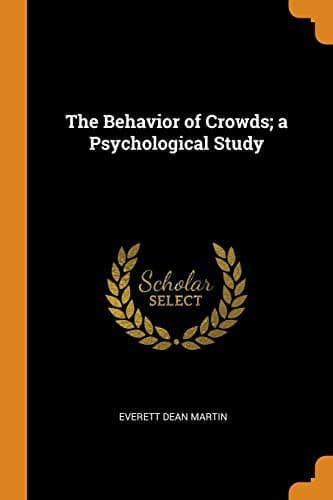
The Behavior of Crowds: A Psychological StudyMartin, Everett Dean
Science
The Behavior of Crowds: A Psychological Study
Martin, Everett Dean
Crowds
Humanistic studies when set in opposition to study of nature are
hampered. They tend to reduce themselves to exclusively literary
and linguistic studies, which in turn tend to shrink to "the
classics," to languages no longer spoken.... It would be hard to
find anything in history more ironical than the educational
practices which have identified the "humanities" exclusively
with a knowledge of Greek and Latin. Greek and Roman art and
institutions made such important contributions to our
civilization that there should always be the amplest
opportunities for making their acquaintance. But to regard them
as _par excellence_ the humane studies involves a deliberate
neglect of the possibilities of the subject-matter which is
accessible in education to the masses, and tends to cultivate a
narrow snobbery--that of a learned class whose insignia are the
accidents of exclusive opportunity. Knowledge is humanistic in
quality not because it is _about_ human products in the past,
but because of what it _does_ in liberating human intelligence
and human sympathy. Any subject-matter which accomplishes this
result is humane and any subject-matter which does not
accomplish it is not even educational.
The point is that it is precisely what a correct knowledge of ancient
civilization through a study of the classics _does_ that our traditional
educators most dread. William James once said that the good which came
from such study was the ability to "know a good man when we see him."
The student would thus become more capable of discriminating
appreciation. He would grow to be a judge of values. He would acquire
sharp likes and dislikes and thus set up his own standards of judgment.
He would become an independent-thinker and therefore an enemy of crowds.
Scholars of the Renaissance knew this well, and that is why in their
revolt against the crowd-mindedness of their day they made use of the
_litteræ humanores_ to smash to pieces the whole dogmatic system of the
Middle Ages.
With the picture of ancient life before him the student could not help
becoming more cosmopolitan in spirit. Here he got a glimpse of a manner
of living in which the controlling ideas and fixations of his
contemporary crowds were frankly challenged. Here were witnesses to
values contrary to those in which his crowd had sought to bring him up
in a docile spirit. Inevitably his thinking would wander into what his
crowd considered forbidden paths. One cannot begin to know the ancients
as they really were without receiving a tremendous intellectual
stimulus. After becoming acquainted with the intellectual freedom and
courage and love of life which are almost everywhere manifest in the
literature of the ancients, something happens to a man. He becomes
acquainted with himself as a valuing animal. Few things are better
calculated to make free spirits than these very classics, once the
student "catches on."
Public-domain text, read in full here on John Shaqi.
Reviews
Reviews
No reviews yet
Be the first to share your thoughts on this work.
Elsewhere in the archive
Join the Discussion
Join the discussion
Sign in to leave a comment or review.
Sign InorCreate an account