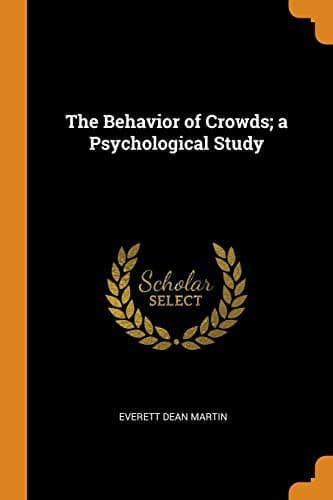
The Behavior of Crowds: A Psychological StudyMartin, Everett Dean
Science
The Behavior of Crowds: A Psychological Study
Martin, Everett Dean
Crowds
As a matter of fact the pragmatic theory of intelligence means
that the function of mind is to project new and more complex
ends to free experience from routine and caprice. Not the use of
thought to accomplish purposes already given either in the
mechanism of the body or in that of the existent state of
society, but the use of intelligence to liberate and liberalize
action, is the pragmatic lesson.... Intelligence as intelligence
is inherently forward looking; only by ignoring its primary
function does it become a means for an end already given. The
latter is servile, even when the end is labeled moral,
religious, esthetic. But action directed to ends to which the
agent has not previously been attached inevitably carries with
it a quickened and enlarged spirit. A pragmatic intelligence is
a creative intelligence, not a routine mechanic.
Hence humanism breaks down the conformist spirit of crowds. From the
simplest to the most complex, ideas are regarded as primarily motor, or,
rather, as guides to our bodily movements among other things in our
environment. James says that the stream of life which runs in at our
eyes and ears is meant to run out at our lips, our feet, and our
fingertips. Bergson says that ideas are like snapshots of a man running.
However closely they are taken together, the movement always occurs
between them. They cannot, therefore, give us reality, or the movement
of life as such, but only cross-sections of it, which serve as guides in
directing the conscious activity of life upon matter. According to James
again, there are no permanently existing ideas, or impersonal ones; each
idea is an individual activity, known only in the thinking, and is
always thought _for a purpose_. As all thinking is purposive, and
therefore partial, emphasizing just those aspects of things which are
useful for our present problem, it follows that the sum total of partial
views cannot give us the whole of reality or anything like a true copy
of it. Existence as a whole cannot be reduced to any logical system. The
One and the Absolute are therefore meaningless and are only logical
fictions, useful, says James, by way of allowing us a sort of temporary
irresponsibility, or "moral holiday."
Public-domain text, read in full here on John Shaqi.
Reviews
Reviews
No reviews yet
Be the first to share your thoughts on this work.
Elsewhere in the archive
Join the Discussion
Join the discussion
Sign in to leave a comment or review.
Sign InorCreate an account