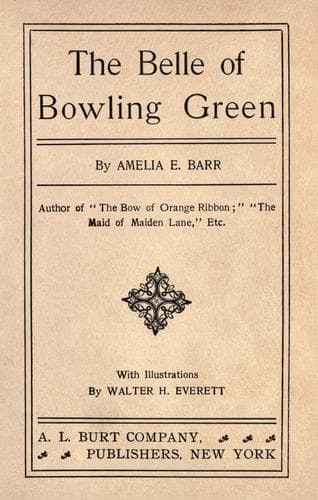
New York (N.Y.) -- Social life and customs -- 19th century -- Fiction; United States -- History -- War of 1812 -- Fiction
“Hamilton had publicly called Burr unprincipled, dangerous, despicable,
an American Cataline--oh, many other derogatory epithets! Would not Mr.
Burr have been generally held as despicable if he had not defended his
good name?”
“By killing his defamer?”
“Well, sir, how else could he have done it?”
“In politics men call each other all sorts of ill names. They even
invent new ones for their opponent. And though in Paradise the lion will
lie down with the lamb, in Paradise they will not have to submit their
rival political views to general elections. Say that Mr. Hamilton was
vituperative--it was a war of words. Mr. Burr Had a tongue and a pen,
as well as Mr. Hamilton. If Mr. Hamilton had insulted Mr. Burr’s wife,
or run off with his daughter, there might have been some excuse for a
bloody settlement, but words, words, words, the tongue or the pen would
have answered them.”
“Then, judge, you do not approve of the duel?”
“I do not. But I think that Mr. Burr’s fatal mistake will eventually put
duelling as much out as witchcraft. We shall probably also have strong
repressive laws against it.”
“Yet as long as public opinion respects duelling, no repressive law will
be as strong as public opinion. We are as moral and intelligent now as
any people can be, yet the duel is not obsolete, nor has Mr. Burr’s
ostracism been a deterrent.”
“I know that. Last year two men quarrelled about an umbrella in the hall
of Scudder’s Museum, and the next day one of them shot the other dead.
Nine out of ten people called the dead man a fool for his pains. Mr.
Murray, the duel has become perilously close to the ridiculous. Men may
talk about blowing out brains for an angry word, but the majority
quietly laugh at the absurdity. Such conduct is totally unworthy of
American common sense. For no man of intelligence would fight a duel if
he remembered that he would render himself liable to form the text for
an article in _The Morning Chronicle_. To be treated either with its
satire or its morality would be equally depressing--it would make him
intensely ridiculous in any case. But we shall never give up duelling
on moral and intelligent grounds.”
“Then on what other grounds?”
“The class duellists come from are the brainless class; and if the
custom was strictly confined by this class to their fellows, it would be
one of the most innocent of their amusements. We must make duelling
ridiculous, for when mockery and satire are constant about any subject,
you may know that thing is dead, and its shell only remains.”
“But, judge, if a man’s honour is assailed----”
“If we were all Hotspurs, Mr. Murray, and ready to plunge into the deep
and pluck honour by the locks, we might count on sympathy; but when the
majority think with Falstaff, that ‘honour is a mere scutcheon’ we get a
chill, until we remember the divine law. For after all, sir, the
Decalogue remains as a finality. Look up the sixth clause of that code.”
“There is nothing to add to it, sir.”
Public-domain text, read in full here on John Shaqi.
Reviews
Reviews
No reviews yet
Be the first to share your thoughts on this work.
Elsewhere in the archive
Join the Discussion
Join the discussion
Sign in to leave a comment or review.
Sign InorCreate an account