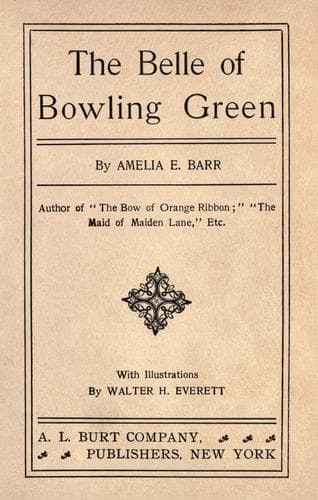
New York (N.Y.) -- Social life and customs -- 19th century -- Fiction; United States -- History -- War of 1812 -- Fiction
The judge looked helplessly at his wife. She was watching the young
couple with smiles on her face, and evident sympathy in her heart for
their cause. If he wished to be adverse and disagreeable, he foresaw he
would have no help from Mrs. Bloommaert. Yet to give up in a moment all
the wavering feelings of dislike he had entertained for Leonard, and all
his own settled purpose of no recognised engagement for his daughter
until peace was accomplished, was a hard struggle. Perhaps it was well
he had to decide in a moment. At that precise hour he was in a mood of
liking Leonard, and he had no time to reason himself into another mood.
Slowly, and with a little asperity, he answered:
“Mr. Murray, it seems to me you have not waited either for my sanction
or my permission.”
“Ah, sir, consider the temptation.”
Involuntarily he looked into the face of “the temptation.” With clear,
shining eyes she held his eyes a moment, and then her voice uttered the
undeniable entreaty: “I love Leonard so dearly, father. And he loves
me.”
“I see! I see!”
“We only wish to please you, father; that is best of all.”
“Indeed, sir, that is best of all!” said Leonard eagerly.
“Well, well! In this country the majority rules. What can a man do if
there are three against him, especially when one of the three is his
wife?” and he shook his head, and looked somewhat reproachfully at his
wife.
Then Sappha slipped her arms around his neck, and laid her cheek against
his, and he embraced his daughter and stretched out his hand to Leonard.
Thus Fortune often brings in the boats we do not steer, and by what we
call a happy accident guides our dearest and most difficult hopes to a
sudden fruition. It is then a good thing to leave the door wide open for
our unknown angels. They often accomplish for us what we hardly dare to
attempt.
After this settlement Sappha and Leonard felt that they might revel in
the joy of life and take their pleasure where-ever they found it. And
they found it both in public and private affairs. Annette’s marriage was
to take place in June, and there were preparations without end going on
for that event. Her grandfather De Vries had given her, as a wedding
gift, the Semple place, a beautiful old home set in a fine garden which
had once sloped down to the river bank.
“It is not exactly what I should have chosen,” said the bride-elect;
“but it is valuable property, and grandfather would not have given it to
me if I had not promised to live there.”
“It is no hardship to live in the Semple house,” said Sappha. “The rooms
are so large, the woodwork so richly carved, and the garden is the
sweetest, shadiest place in New York, I think.”
“Grandmother is going to furnish it, and she lets me choose exactly what
I want. I declare, dear Achille and I have no time for love-making, we
are so worried about chairs and tables and wedding garments.”
“I never should have thought Achille would worry about anything. He is
always so deliberate, and so calm.”
Public-domain text, read in full here on John Shaqi.
Reviews
Reviews
No reviews yet
Be the first to share your thoughts on this work.
Elsewhere in the archive
Join the Discussion
Join the discussion
Sign in to leave a comment or review.
Sign InorCreate an account