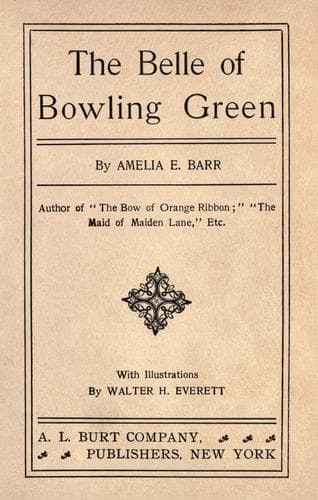
New York (N.Y.) -- Social life and customs -- 19th century -- Fiction; United States -- History -- War of 1812 -- Fiction
Leonard had, indeed, gone to the guard-room of the Jersey Blues, but his
visit was decidedly against his inclination. He was as weary as Mrs.
Bloommaert had supposed him to be--weary of the Bourbons, and of the
passionate fratching about them; weary of men, and of women also; weary
of companionship of all kinds; weary of noise and strain of the restless
city; weary of life itself. Vital and large as his nervous force was, it
had become exhausted; feeling had wasted it, and disappointment been
equally depleting. He resolved when he turned from the Bloommaert house
to go direct to his rooms in the City Hotel and seek in solitude and
sleep a renewal of strength and hope. On the steps of the hotel an old
acquaintance accosted him, and Leonard rather reluctantly asked “if he
had come to see him?”
“Yes,” answered the man. “I am in trouble, Mr. Murray, and I could think
of no one but you to give me some advice. It is about Miss Martin. You
remember pretty Sarah Martin? We were engaged, and she has broken the
engagement. I am very unhappy. I do not know what to do. I think you can
tell me.”
“I am going to my rooms now. Come upstairs with me, McKenzie.”
“I cannot. I must be back at the guard-room in half an hour. Will you
not go with me? We can talk there well enough.”
Then Leonard went with McKenzie, and after the little formalities with
the men present in the guard-room were over, Leonard and McKenzie took
chairs to an open window and began their consultation. And very soon
Leonard threw off his lassitude and became heartily interested in his
friend’s trouble. Suddenly a voice, blatant and dictatorial, fell upon
his consciousness. It was the voice of a man who had been a member of
the company raised by Leonard, and who during the whole term of its
service was a source of annoyance and disputing--a man of low birth and
of a mean, envious nature, who had neither a good education nor good
breeding, and, indeed, who affected to despise both. Leonard’s youth,
beauty, fine culture, and fine manners, added to his great wealth and
popularity, roused at once Horace Gilson’s envy; and envy in the close
companionship of a military fort quickly grew to an almost
uncontrollable hatred. And in Gilson’s nature hatred had its proper
soil; he was insensible to the nobler qualities of humanity, and
persuaded himself--and other of his kind--that Leonard’s gracious
forbearance was not the fine courtesy of an officer to his subordinate,
but the fear of a timid and effeminate spirit. Indeed, Leonard’s three
months’ service had been made an hourly trial by the hardly concealed
mockery and contempt of Horace Gilson. Of all men in the wide world he
was the very last Leonard wished to see. He moved his chair a little
nearer to McKenzie, and by so doing faced the open window only. McKenzie
continued talking, unmindful of Gilson’s entrance, but Leonard heard
above all he said the sneering taunt and scoffing laugh of the man he
despised and disliked.
Public-domain text, read in full here on John Shaqi.
Reviews
Reviews
No reviews yet
Be the first to share your thoughts on this work.
Elsewhere in the archive
Join the Discussion
Join the discussion
Sign in to leave a comment or review.
Sign InorCreate an account