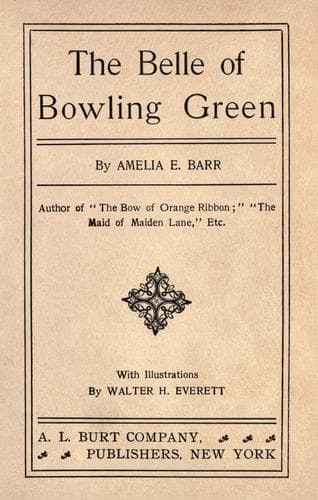
New York (N.Y.) -- Social life and customs -- 19th century -- Fiction; United States -- History -- War of 1812 -- Fiction
Prone upon her bed she lay, torturing herself by a thousand
self-reproaches, and by a perpetual memory of that last look of pained
amazement with which her lover had regarded her. She could not put it
from her, it seemed to have exorcised every other memory of his face.
With heartbroken sobs she sent after him one cry, “Forgive me! Oh,
Leonard, forgive me!” But the void between them swallowed it up in
silence. There was nothing to be done. The long, long days and years
before her held only frustrate longings and despair. This reflection
came to her as a finality, and she ceased weeping and protesting and lay
dumb and passive like a child smitten by a power it can neither appease
nor comprehend.
Her mother found her in this mood, and when Sappha said, “I cannot come
to dinner to-day, I am in trouble. Annette told me things about Leonard,
and I have sent him away forever!” the mother understood and was full of
pity.
“Do not try to come down, dear,” she answered. “As soon as your father
goes out, I will return to you.”
“Are you better, mother? Are you able to attend to father?”
“Yes, yes, I am well again. Ah, me, there is always sorrow at somebody’s
heart!”
“It is my own fault, mother. Leonard is not to blame. I will tell
you--after a little while.”
Then Mrs. Bloommaert went with a heavy heart to serve the dinner; for
whether heads are aching or hearts breaking dinner is a fact that cannot
be excused. She was full of anxious thought as she went about the
table, placing sauces, condiments, and wines, and arranging the small
details which always pleased her husband. He had been depressed and
angry concerning Leonard Murray’s conduct for some days, and she
wondered how the news of Sappha’s dismissal of the young man would
affect him.
Contrary to all expectation he entered the house in high spirits. He was
delighted to find his wife better, and able to give him her company and
sympathy; and as soon as they were alone he began to talk to her about
Leonard in a manner full of pride and satisfaction. Nor was he much
dashed by the information that there had been a quarrel between the
lovers, and a final separation.
“Final separation!” he repeated, with an incredulous laugh. “Nonsense.
That is a regular climax to a love fever. They will be more devoted than
ever in a week’s time. Tell her what I have just told you, and they will
be friends in half an hour.”
“I fear not. Leonard has shown wonderful patience so far, but my father
used to say ‘beware the anger of a patient man’; for when once his
patience has given way, his anger is not to be pacified.”
“All foolishness, Carlita. Go and tell Sappha everything. I promised to
meet St. Ange about three o’clock; you see I have not any time to spare
now.”
“I do not know what Annette said to Sappha--something ill-natured, no
doubt; but I wonder St. Ange did not give her strict orders to keep her
tongue quiet about this business.”
Public-domain text, read in full here on John Shaqi.
Reviews
Reviews
No reviews yet
Be the first to share your thoughts on this work.
Elsewhere in the archive
Join the Discussion
Join the discussion
Sign in to leave a comment or review.
Sign InorCreate an account