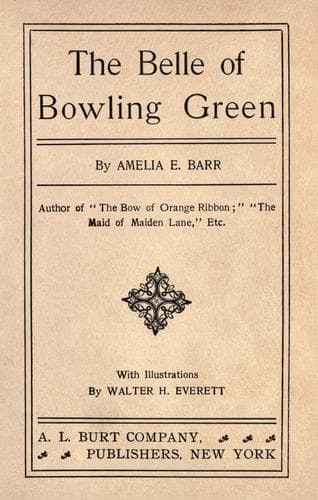
New York (N.Y.) -- Social life and customs -- 19th century -- Fiction; United States -- History -- War of 1812 -- Fiction
“You are very provoking, Sapphira. And I can tell you one thing, they
that are determined to be miserable will always find the wherewithal for
misery. Try and hope for the best,” and she kissed her and added, “Put
on a fresh white frock, you look best in white.”
So Sappha did as she was counselled, but her bravery did not help her to
bear her sorrow--a sorrow made worse by its uncertainty in all respects.
If Leonard had only granted her a little time, if he had been patient
enough to tell her of the morning’s events, if he had not given that
rose of renunciation! Yes, that act of his was the real provocative of
her desertion. He had told her to forget him. What could he expect but a
prompt acceptance of his request? It would have been impossible at that
stage to have hesitated. He had broken their betrothal, not her; how
then could she hope he would make any effort to renew it?
She did not hope for it, though she obeyed her mother’s desire, and with
an aching heart dressed herself in white and went downstairs. About five
o’clock she heard her father’s steps, and he was not alone. But the
double footsteps did not give her a moment’s hope. She knew they were
not Leonard’s, and in a few moments she saw that St. Ange was her
father’s companion. They were talking in tones of earnest gratification,
and as soon as the ordinary greetings were over resumed their
conversation.
The subject was, of course, the duel and the sympathetic response it had
evoked in Leonard’s favour. Gilson’s effort to escape to Boston, his
bullying language when detected, the decided white feather he had shown
on the field, his cowardice under pain since he had received his
punishment, were now the topics of public conversation; and the men who
had been foremost in doubting Leonard Murray were now the warmest in his
praise. All these things St. Ange described in his usual sparkling
detail, and the judge, Mrs. Bloommaert, and Sappha listened to him with
the keenest interest.
Suddenly Judge Bloommaert said: “I never heard before of a man disabling
his antagonist just in that way. I wonder how Leonard learned the
stroke.”
“One of Robespierre’s emigrants taught it to Leonard. He was a noble of
the highest lineage, but when driven to America he embraced the simple
life of the wilderness with inconceivable ardour. Leonard met him in the
exploring party which he accompanied to the Mississippi, and together
they went down the river to New Orleans. Their tedious voyage was
relieved with sword play, and under this French noble’s tuition Leonard
became an incomparable fencer. With this same stroke he disarmed Señor
Zavala in New Orleans.”
“Ah! Then Murray has fought before?”
“Yes. The duel between Señor Zavala and Mr. Murray is well remembered in
New Orleans.”
“Suppose, then, you tell us about it,” said Mrs. Bloommaert.
“I was not acquainted with Leonard at the time, but Mr. Livingston told
me of the circumstance. The Americans in New Orleans are proud of it.”
Public-domain text, read in full here on John Shaqi.
Reviews
Reviews
No reviews yet
Be the first to share your thoughts on this work.
Elsewhere in the archive
Join the Discussion
Join the discussion
Sign in to leave a comment or review.
Sign InorCreate an account