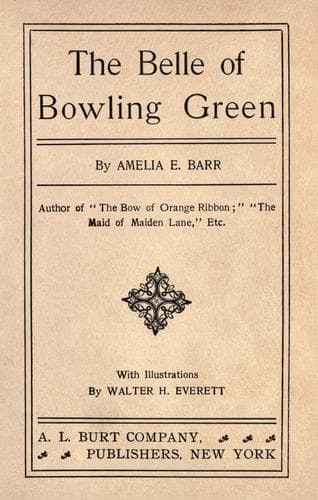
New York (N.Y.) -- Social life and customs -- 19th century -- Fiction; United States -- History -- War of 1812 -- Fiction
All these considerations gave a sort of fatality to her quarrel with
Leonard, but they did not induce any kinder feeling towards Annette. She
regarded her, if not as the author, at least as the tool and messenger,
of evil; and Annette was quickly made to feel her position. Of course
she was angered by it. And Annette was easily made angry at this time,
for Achille had never been so provoking and unmanageable. In spite of
her complaints, he had lately spent all his days with De Singeron, who
was now on the point of sailing for France; and the episode of Leonard’s
duel had been specially aggravating, because she had not been taken into
confidence concerning it. And with that singular obtuseness common to
selfish people, she considered Mrs. Bloommaert’s coolness and Sappha’s
constant refusals to see her as a quite uncalled-for show of offence.
She told herself she had only repeated what every one was saying, and
that if Sappha had any sense of what was proper and respectable she
would have been grateful for her candour. “People are always asking to
be told the truth,” she complained, “and then when you put yourself out
of the way to tell it, they are sure to be angry at you.”
When three weeks had passed in this uncomfortable manner, Annette began
seriously to miss her accustomed sources of that familiar friendship
which admits of confidence and some showing of individuality. She awoke
one morning with a sense of isolation and of not being properly loved
and cared for; that was too intolerable to be endured longer, and taking
little Jonaca with her as a kind of peacemaker, she called on her aunt
and Sappha. As the carriage drew up at the Bloommaert house she saw
Sappha rise, and when she entered the parlour only Mrs. Bloommaert was
present.
“Good-morning, aunt Carlita! I have brought Jonaca to see you.”
Mrs. Bloommaert kissed the babe, and said she “looked well,” and then
resumed her sewing.
“Where is Sappha, aunt?”
“She is in her room. She is not well, and I cannot disturb her.”
“Oh, indeed, aunt, I saw her as I passed the window. She need not run
away from me.”
“Has Sappha run away from you? Why has she done that?”
“I suppose because I told her some things about Leonard Murray. It was
right for her to know them; but I have no doubt, now that Leonard has
run away, she blames me for all his faults.”
“Leonard has not run away, and it is very wrong and very spiteful in you
to make such remarks.”
“Nobody knows where he is, and he has left New York. What do you call
that, aunt?”
“I call it minding his own affairs, and as for saying no one knows where
he is, that is a lie. Because he did not tell Annette St. Ange where he
was going, is that proof that he has told no one? Indeed, Annette, if
you can believe it, there are a few people of consequence in New York
beside yourself--and Mr. St. Ange.”
Public-domain text, read in full here on John Shaqi.
Reviews
Reviews
No reviews yet
Be the first to share your thoughts on this work.
Elsewhere in the archive
Join the Discussion
Join the discussion
Sign in to leave a comment or review.
Sign InorCreate an account