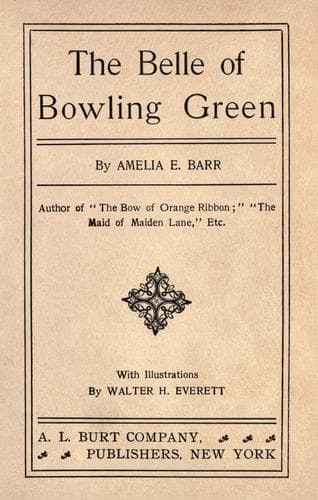
New York (N.Y.) -- Social life and customs -- 19th century -- Fiction; United States -- History -- War of 1812 -- Fiction
“I think Sappha is quite right. The stand she has taken is unassailable.
We must make the best of what she concedes. If Sappha still regards
Leonard as her future husband, she can do no less.”
“But, my son----”
“Yes, my mother, I know what you would say, but in this case my daughter
is right. I shall stand by my daughter.”
Then Sappha went to her father, and he put his arm around her and kissed
her, and told her, “he was sure she would do the very best she could,
and so he trusted her.”
In accordance, therefore, with the promise made, and the obligation
implied by her father’s confidence, Sappha remained in the parlour when
Annette called the next day. She came in her most expansive and effusive
mood; kissed her aunt, and then in a kind of mock contrition asked
Sappha if she might be permitted to kiss her also?
“I do not deserve a kiss, Sappha, I know I do not; but I am a little
sinner to every one, and there is nothing I can do but say ‘Annette is
sorry.’ And really I am sorry. If there is anything I can do, to undo my
foolishness----”
“There is nothing, Annette.”
“It is too bad. I never dreamed of Leonard taking offence at you; every
one was saying unkind things, and I thought you ought to know. I was
really very miserable that morning. I hardly knew what I was saying. But
the idea of Leonard going away from all his friends--and you!--that
never occurred to me.”
“We will not speak of Mr. Murray. There are other things to talk of.”
“Indeed yes. Have you heard that Mary Sebring is going to Washington?
Many people say, because Captain Ellis is there.”
“How is Jonaca? Why did you not bring her?”
“I left her with grandmother. She is well enough.”
This strained social intercourse was soon invaded by news of menacing
national importance. The British fleet was being constantly increased,
the blockade very strictly enforced, and the real conflict felt to be
near at hand. The entire populace was now divided into two great
parties; one was for war, the other for peace; and the fear of disunion
of the States hung heavy over all.
On the Fourth of July the President had made a call for 93,500 militia;
and before the middle of the month alarm for the safety of New York was
so great that the men exempt from military duty formed themselves into
companies to aid in its defence. On the third of August Mayor Clinton,
in an address to the people, said:
“This city is in danger! We are threatened with invasion. It is the duty
of all good citizens to prepare for the crisis. Let there be but one
voice among us. Let every arm be raised to defend our country; our
country demands our aid. She expects that every free man will be found
at his post in the hour of danger, and that every free citizen of New
York will do his duty.”
Public-domain text, read in full here on John Shaqi.
Reviews
Reviews
No reviews yet
Be the first to share your thoughts on this work.
Elsewhere in the archive
Join the Discussion
Join the discussion
Sign in to leave a comment or review.
Sign InorCreate an account