"The story is full of them," said the friend, who had had them all
pointed out to him, different ones each time, during those evenings of
howling tempests and indoor peace--the perfect peace of pipes, hot
stoves, and _Glühwein_.
"The other," said Manske, "is, that it is very sinful for little girls
to write love-poetry in the name of their aunts."
"To write love-poetry is at no time the function of little girls," said
the friend.
"Such conduct cannot be too strongly censured," said Manske. "But to do
it in the name of someone else is not only not _mädchenhaft_, it is
sinful."
"These English little girls appear to know no shame," said his wife.
"Truly they might learn much from our own female youth," said the
friend.
Letty's poems had undoubtedly been the indirect cause of the fire, of
Axel's arrest, and of his marriage with Anna. But if they had brought
about Anna's happiness, a happiness more complete and perfect than any
of which she had dreamed, they had also brought about Klutz's ruin. For
Klutz, shattered in nerves, weak of will, overcome by the state of his
conscience and the possible terrors of the next world, with the blood of
three generations of pastors in his veins, every drop of which cried out
to him day and night to save his soul at least, whatever became of his
body, Klutz had confessed. He was only twenty, he knew himself to be
really harmless, he had never had any intentions worse than foolish, and
here he was, ruined. The act had been an act of temporary madness; and
influenced by Dellwig, he had saved his skin afterwards as best he
could. Now there was the price to pay, the heavy price, so tremendous
when compared to the smallness of the follies that had led him on step
by step. His bad genius, Dellwig, went free; and later on lived
sufficiently far away from Kleinwalde to be greatly respected to the end
of his days. Manske's eyes filled with tears when he came to the action
of Providence in this matter--the mysteriousness of it, the utter
inscrutableness of it, letting the morally responsible go unpunished,
and allowing the poor young vicar, handicapped from his very entrance
into the world by his weakness of character, to be overtaken on the
threshold of life by so terrific a fate. "Truly the ways of Providence
are past finding out," said Manske, sorrowfully shaking his head.
"I never did believe in Klutz," said his wife, thinking of her apple
jelly.
"Woman, kick not him who is down," said her husband, turning on her with
reproachful sternness.
"Kick!" echoed his wife, tossing her head at this rebuke, administered
in the presence of the friend; "I am not, I hope, so unwomanly as to
kick."
"It is a figure of speech," mildly explained the friend.
"I like it not," said Frau Manske gloomily.
"Peace," said her husband.
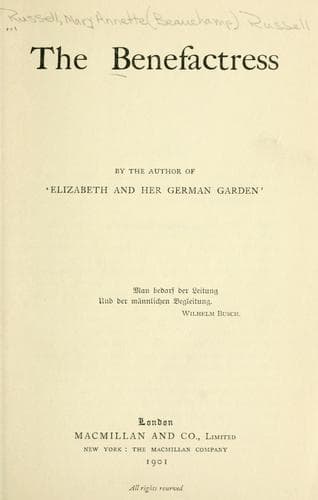
BY THE SAME AUTHOR
Elizabeth and Her German Garden
Public-domain text, read in full here on John Shaqi.
Reviews
Reviews
No reviews yet
Be the first to share your thoughts on this work.
Elsewhere in the archive
Join the Discussion
Join the discussion
Sign in to leave a comment or review.
Sign InorCreate an account