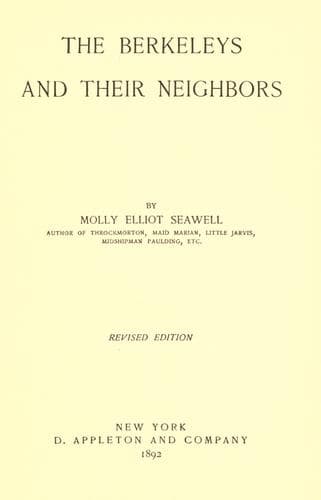
The Berkeleys and their neighborsSeawell, Molly Elliot
General
The Berkeleys and their neighbors
Seawell, Molly Elliot
Virginia -- Fiction
THE quaint old house, and the straggling, half-kept grounds at Isleham
were never lovelier than that spring. Sometimes the extreme quiet and
repose had weighed upon Olivia’s spirits as it would upon any other
young and vigorous nature. But now she had a good deal of a certain
sort of excitement. She was country-bred, and naturally turned to
the country for any home feeling she might have. The Colonel and
Petrarch were a little bored at first. Both missed the social life at
Washington. Pete had been a success in his own circle. His ruffled
shirt-front, copied from his master’s, had won infinite respect among
his own color. As for the natty white footmen and coachmen, their
opinion and treatment, even their jeers, he regarded with lofty
indifference, and classed them as among the poorest of poor white trash.
His religion, too, had struck terror to those of the Washington darkies
to whom he had had a chance to expound it. His liberal promises of
eternal damnation, “an’ sizzlin’ an’ fryin’ in perdition, wid de devil
bastin’ ’em wid de own gravy,” had not lost force even through much
repetition. “Ole marse,” Petrarch informed Olivia, “he cuss ’bout dem
dam towns, an’ say he aint had nuttin’ fittin’ ter eat sence he lef’
Verginny. Ole marse, he jis’ maraudin’ an’ cussin’ ’cause he aint got
nuttin’ ter do. I lay he gwi’ back naix’ year. Ef he does, I got some
preachments ter make ter dem wuffless niggers d’yar, totin’ de sins
’roun’ like twuz’ gol’ an’ silver.”
It seemed as if Olivia were destined to suffer a good deal of secret
mortification on Pembroke’s account. That last neglect of his had cut
her to the soul. She had waked up to the fact, however, that Pembroke
had taken his first rebuff in good earnest, and that nothing was left
for her but that hollow pretense of friendship which men and women who
have been, or have desired to be, more to each other, must affect. It
was rather a painful and uncomfortable feeling to take around with her,
when listening to Mrs. Peyton’s vigorous talk, or the Rev. Mr. Cole’s
harmless sermons, and still more harmless conversation. But it was
there, and it was unconquerable, and she must simply adjust the burden
that she might bear it.
The county was full of talk about Pembroke’s speech. The older people
were sure that some information of his father’s great speeches in
their court-house about 1849 must have reached Washington, and that
Pembroke’s future was predicated upon them. Then there was a good deal
in the newspapers about it. The Richmond papers printed the speech in
full, together with a genealogical sketch of his family since the first
Pembroke came over, with a grant of land from Charles the Second in
his pocket. Likewise, Pembroke’s success was attributed almost wholly
to his ancestry, and he himself was considered to have had a merely
nominal share in it.
Public-domain text, read in full here on John Shaqi.
Reviews
Reviews
No reviews yet
Be the first to share your thoughts on this work.
Elsewhere in the archive
Join the Discussion
Join the discussion
Sign in to leave a comment or review.
Sign InorCreate an account