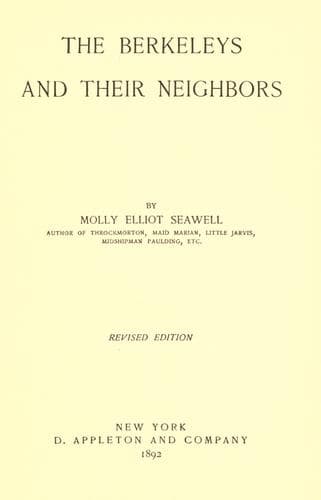
The Berkeleys and their neighborsSeawell, Molly Elliot
General
The Berkeleys and their neighbors
Seawell, Molly Elliot
Virginia -- Fiction
The most personal and in some respects the most important work which
Mr. Harris has published since “Uncle Remus.” Many will read between
the lines and see the autobiography of the author. In addition to the
stirring incidents which appear in the story, the author presents a
graphic picture of certain phases of Southern life which have not
appeared in his books before. There are also new examples of the
folk-lore of the negroes, which became classic when presented to the
public in the pages of “Uncle Remus.”
“The book is in the characteristic vein which has made the
author so famous and popular as an interpreter of plantation
character.”--_Rochester Union and Advertiser._
“Those who never tire of Uncle Remus and his stories--with whom
we would be accounted--will delight in Joe Maxwell and his
exploits.”--_London Saturday Review._
“Altogether a most charming book.”--_Chicago Times._
“Really a valuable, if modest, contribution to the history of the
civil war within the Confederate lines, particularly on the eve of the
catastrophe. While Mr. Harris, in his preface, professes to have lost
the power to distinguish between what is true and what is imaginative
in his episodical narrative, the reader readily finds the clew. Two or
three new animal fables are introduced with effect; but the history
of the plantation, the printing-office, the black runaways, and white
deserters, of whom the impending break-up made the community tolerant,
the coon and fox hunting, forms the serious purpose of the book,
and holds the reader’s interest from beginning to end. Like ‘Daddy
Jake,’ this is a good anti slavery tract in disguise, and does credit
to Mr. Harris’s humanity. There are amusing illustrations by E. W.
Kemble.”--_New York Evening Post._
“A charming little book, tastefully gotten up.... Its simplicity,
humor, and individuality would be very welcome to any one who was
weary of the pretentiousness and the dull obviousness of the average
three-volume novel.”--_London Chronicle._
“The mirage of war vanishes and reappears like an ominous shadow on
the horizon, but the stay-at-home whites of the Southern Confederacy
were likewise threatened by fears of a servile insurrection. This
dark dread exerts its influence on a narration which is otherwise
cheery with boyhood’s fortunate freedom from anxiety, and sublime
disregard for what the morrow may bring forth. The simple chronicle
of old times ‘on the plantation’ concludes all too soon; the fire
burns low and the tale is ended just as the reader becomes acclimated
to the mid-Georgian village, and feels thoroughly at home with Joe
and Mink. The ‘Owl and the Birds,’ ‘Old Zip Coon,’ the ‘Big Injun and
the Buzzard,’ are joyous echoes of the plantation-lore that first
delighted us in ‘Uncle Remus.’ Kemble’s illustrations, evidently
studied from life, are interspersed in these pages of a book of
consummate charm.”--_Philadelphia Ledger._
Public-domain text, read in full here on John Shaqi.
Reviews
Reviews
No reviews yet
Be the first to share your thoughts on this work.
Elsewhere in the archive
Join the Discussion
Join the discussion
Sign in to leave a comment or review.
Sign InorCreate an account