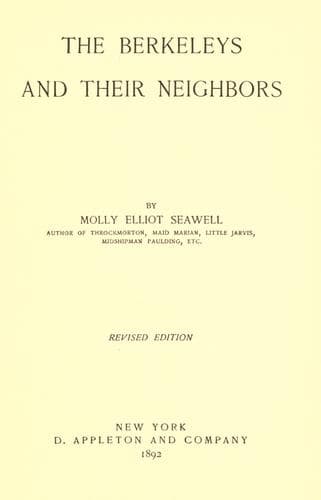
The Berkeleys and their neighborsSeawell, Molly Elliot
General
The Berkeleys and their neighbors
Seawell, Molly Elliot
Virginia -- Fiction
Luckily for Pembroke, he could plunge into the heat of his canvass.
After he had lost Olivia, the conviction of her value came to him
with overpowering force. There was no girl like her. She did not
protest and talk about her emotions and analyze them as some women
did--Madame Koller, for example--but Pembroke knew there was “more
to her,” as Cave said, “than a dozen Eliza Peytons.” Perhaps Cave
suspected something, but Pembroke knew he had nothing to fear from his
friend’s manly reticence. But to have lost Olivia Berkeley! Pembroke
sometimes wondered at himself--at the way in which this loss grew upon
him, instead of diminishing with time, as the case usually is with
disappointments. Yet all this time he was riding from place to place,
speaking, corresponding, as eager to win his election as if he were the
happiest of accepted lovers--more so, in fact.
And then, there was that Ahlberg affair to trouble him. Like all the
men of his race and generation, he firmly believed there were some
cases in which blood must be shed--but a roadside quarrel, in which
nothing but personal dislike figured, did not come under that head.
Pembroke was fully alive to the folly and wickedness of fighting
Ahlberg under the circumstances--but it was now impossible for him to
recede. He could only hope and pray that something would turn up to
prevent a meeting so indefinitely fixed. But if Ahlberg’s going away
were the only thing to count upon, that seemed far enough out of the
question, for he stayed on and on at the village tavern, playing cards
with young Hibbs and one or two frequenters of the place, riding over
to play Madame Koller’s accompaniments, fishing for invitations to
dine at Isleham--in short, doing everything that a man of his nature
and education could do to kill time. Pembroke could not but think that
Ahlberg’s persistence could only mean that he was really and truly
waiting for his revenge. So there were a good many things to trouble
the “white man’s candidate,” who was to make such a thorough and
brilliant canvass, and whose readiness, cheerfulness and indomitable
spirit was everywhere remarked upon.
One night, as Pembroke was riding home after a hard day’s work in the
upper part of the county, and was just entering the long straggling
village street, his horse began to limp painfully. Pembroke dismounted,
and found his trusty sorrel had cast a shoe,--a nail had entered his
foot, and there was a job for the blacksmith. He led the horse to the
blacksmith’s shop, which was still open, although it was past seven
o’clock, and on the promise of having the damage repaired in half an
hour, walked over to the village tavern.
Public-domain text, read in full here on John Shaqi.
Reviews
Reviews
No reviews yet
Be the first to share your thoughts on this work.
Elsewhere in the archive
Join the Discussion
Join the discussion
Sign in to leave a comment or review.
Sign InorCreate an account