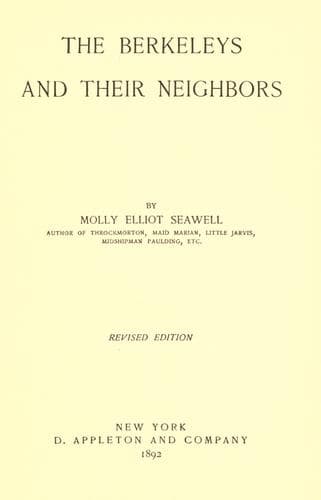
The Berkeleys and their neighborsSeawell, Molly Elliot
General
The Berkeleys and their neighbors
Seawell, Molly Elliot
Virginia -- Fiction
Without a word Ahlberg reached down, and from some unknown depths
produced the card. He was no coward, but he was overmastered physically
and mentally. He knew in an instant that Pembroke had seen it all, and
there was no shadow of escape for him.
Pembroke let go of Ahlberg’s collar, and, taking out a white
handkerchief, wiped his hands carefully. Ahlberg had sunk back,
panting, in a chair. The grip of a hand like Pembroke’s in the
neighborhood of the wind-pipe is calculated to shorten the breath.
Hibbs looked dazed, from one to the other, and then to the floor, where
the cards had fallen. The one damning card lay on the table.
“I saw it twice before this, in the glass,” said Pembroke to Hibbs.
“Each time I tried to catch him, but he did it so well I couldn’t. But
the last time it was perfectly plain,--you see. I could see under the
table in the glass. You had better pick up your money, Hibbs.”
At this, Ahlberg spoke up.
“All of it is Monsieur Hibbs’,” he said with elaborate politeness,
recovering his breath a little, “except two fifty-dollar notes, which
are mine.”
Pembroke picked out the two fifty-dollar notes and dashed them in
Ahlberg’s face, who very cleverly caught them and put them in his
pocket.
“Mr. Pembroke,” said Hibbs, stammering and blushing, “I--I--hope you
won’t say anything about this, sir. It would ruin me--I don’t mean in
the canvass, for I tell you truly, sir, I hope you’ll be elected, and
if it wasn’t for the party, I’d give up the fight now. But my mother,
sir, don’t approve--don’t approve of playing for money--and--”
“You are perfectly safe,” answered Pembroke, “and quite right in your
idea of duty to your party, and your dislike to wound your mother is
creditable. But as for this dog, he must leave this county at once.”
Ahlberg said not a word. He did not lack mere physical courage, but
cheating at cards was, to him, the most heinous offense of which
he could be convicted. He had been caught--it was the fortune of
war--there was nothing to be said or done. At least, it happened in
this out-of-the-way corner of the world, where it could never be known
to anybody--for he did not count his acquaintances in the country as
anybody, unless--perhaps--Madame Koller. At that he grew pale for the
first time. He really wanted Madame Koller’s money. But, in fact,
he was somewhat dazed by Pembroke’s way of settling the trouble. It
really shocked his ethics to see one gentleman punish another as if he
were a bargeman or a coal heaver. These extraordinary Anglo-Saxons!
But one thing was plain with him--if he did not remain perfectly
quiescent Pembroke was quite capable of throwing him bodily out of the
window--and if he had lost his honor, as he called it, there was no
reason why he shouldn’t save his bones.
Public-domain text, read in full here on John Shaqi.
Reviews
Reviews
No reviews yet
Be the first to share your thoughts on this work.
Elsewhere in the archive
Join the Discussion
Join the discussion
Sign in to leave a comment or review.
Sign InorCreate an account