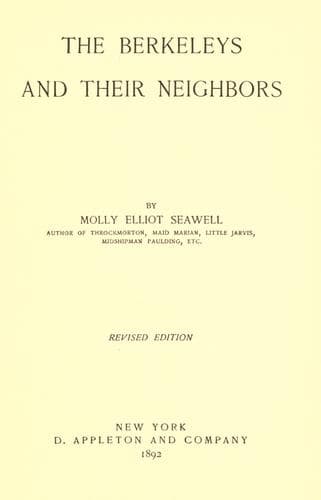
The Berkeleys and their neighborsSeawell, Molly Elliot
General
The Berkeleys and their neighbors
Seawell, Molly Elliot
Virginia -- Fiction
The Colonel’s manner was so very dignified, and although jovial, so far
removed from familiarity, that Madame Volkonsky did not know whether
to be pleased by the recognition or annoyed. If, as it was likely, it
should come out that she was an American, here were people of the best
standing who could vouch at least for her origin. She held out her hand
to the Colonel, and said rapidly in French:
“I am very glad to meet you. I cannot say much here, but I hope to see
you presently.” When Pembroke made his bow and passed, Volkonsky called
up all his ineffable assurance and gave him a scowl, which Pembroke
received with a bow and a cool smile that was sarcasm itself. Madame
Volkonsky did not look at him as she bowed, nor did he look at her.
In a moment they were clear of the press. The De Peysters were full of
curiosity.
“Who were they? Who are they?” breathlessly asked Helena.
“My dear young lady,” responded the Colonel, smoothing down his
shirt-frill with his delicate old hand, “Who they were I can very
easily tell you. Who they are, I am blessed if I know.”
While the Colonel was giving a highly picturesque account of Eliza
Peyton through all her transformations until she came to be Elise
Koller, since when Colonel Berkeley had no knowledge of her whatever,
Pembroke had given his arm to Olivia, and they moved off into a quiet
corner, where the spreading leaves of a great palm made a little
solitude in the midst of the crowd, and the lights and the crash of
music and the beating of the dancers’ feet in the distance. Pembroke
was alternately pale and red. Madame Volkonsky was nothing to him
now, but he hated Volkonsky with the reprehensible but eminently
human hatred that one man sometimes feels for another. Volkonsky was
a scoundrel and an imposter. It made him furious to think that he
should have dared to return to America, albeit he should come as the
accredited Minister of a great power. It showed a defiance of what
he, Pembroke, knew and could relate of him, that was infuriating
to his self-love. For Elise, he did not know exactly what he most
felt--whether pity or contempt. And the very last time that he and
Olivia Berkeley had discussed Madame Koller was on that April night in
the old garden at Isleham--a recollection far from pleasant.
“Papa’s remark that this meeting was delightful, struck me as rather
ingeniously inappropriate,” said Olivia, seeking the friendly cover of
a joke. “It is frightfully embarrassing to meet people this way.”
“Very,” sententiously answered Pembroke. He was still in a whirl.
Then there was a pause. Suddenly Pembroke bent over toward her and said
distinctly:
“Olivia, did you ever doubt what I told you that night in the garden
about Madame Koller? that she was then, and had been for a long time,
nothing to me? Did you ever have a renewal of your unjust suspicions?”
“No,” answered Olivia, as clearly, after a short silence.
Public-domain text, read in full here on John Shaqi.
Reviews
Reviews
No reviews yet
Be the first to share your thoughts on this work.
Elsewhere in the archive
Join the Discussion
Join the discussion
Sign in to leave a comment or review.
Sign InorCreate an account