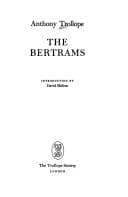
England -- Fiction; Love stories; Scholars -- Fiction
For awhile Bertram thought that Harcourt was the best companion in
the world. He was as agreeable and easy tempered as his father; and
was at the same time an educated man, which his father certainly was
not. Harcourt, though he put his happiness in material things perhaps
quite as much as did Sir Lionel, required that his material things
should be of a high flavour. He was a reading man, addicted, in a
certain cynical, carping sort of way, even to poetry, was a critic
almost by profession, loved pictures, professed to love scenery,
certainly loved to watch and scrutinize the different classes of his
brother-men. He was gifted pre-eminently with a lawyer's mind, but it
was not a lawyer's mind of a vulgar quality. He, too, loved riches,
and looked on success in the world as a man's chief, nay, perhaps
his only aim; but for him it was necessary that success should be
polished. Sir Lionel wanted money that he might swallow it and
consume it, as a shark does its prey; but, like sharks in general,
he had always been hungry,--had never had his bellyful of money.
Harcourt's desire for money was of a different class. It would not
suit him to be in debt to any one. A good balance at his banker's was
a thing dear to his soul. He aimed at perfect respectability, and
also at perfect independence.
For awhile, therefore, Harcourt's teaching was a great improvement
on Sir Lionel's, and was felt to be so. He preached a love of good
things; but the good things were to be corollaries only to good work.
Sir Lionel's summum bonum would have been an unexpected pocketful of
money, three months of idleness in which to spend it, and pleasant
companions for the time, who should be at any rate as well provided
in pocket as himself. Harcourt would have required something more.
The world's respect and esteem were as necessary to him as the
world's pleasures.
But nevertheless, after a time, Harcourt's morality offended Bertram,
as Bertram's transcendentalism offended Harcourt. They admired the
same view, but they could not look at it through the same coloured
glass.
"And so on the whole you liked your governor?" said Harcourt to him
one day as they were walking across a mountain range from one valley
to another.
"Yes, indeed."
"One is apt to be prejudiced in one's father's favour, of course,"
said Harcourt. "That is to say, when one hasn't seen him for twenty
years or so. A more common, constant knowledge, perhaps, puts the
prejudice the other way."
"Sir Lionel is undoubtedly a very pleasant man; no one, I fancy,
could help liking his society."
"I understand it all as well as though you had written a book about
him. You have none of that great art, Bertram, which teaches a man to
use his speech to conceal his thoughts."
"Why should I wish to conceal my thoughts from you?"
Public-domain text, read in full here on John Shaqi.
Reviews
Reviews
No reviews yet
Be the first to share your thoughts on this work.
Elsewhere in the archive
Join the Discussion
Join the discussion
Sign in to leave a comment or review.
Sign InorCreate an account