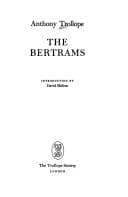
England -- Fiction; Love stories; Scholars -- Fiction
But something must be told of the occurrences of these two years.
In the first place, no marriage had taken place--that is, among our
personages; nor had their ranks been thinned by any death. In our
retrospective view we will give the _pas_ to Mr. Harcourt, for he had
taken the greatest stride in winning that world's success, which is
the goal of all our ambition. He had gone on and prospered greatly;
and nowadays all men at the bar said all manner of good things of
him. He was already in Parliament as the honourable member for the
Battersea Hamlets, and was not only there, but listened to when
it suited him to speak. But when he did speak, he spoke only as a
lawyer. He never allowed himself to be enticed away from his own
profession by the meretricious allurements of general politics.
On points of law reform, he had an energetic opinion; on matters
connected with justice, he had ideas which were very much his own--or
which at least were stated in language which was so; being a denizen
of the common law, he was loud against the delays and cost of
Chancery, and was supposed to have supplied the legal details of a
very telling tale which was written about this time with the object
of upsetting the lord-chancellor as then constituted.
But though he worked as a member only in legal matters, of course he
was always ready to support his party with his vote in all matters.
His party! here had been his great difficulty on first entering the
House of Commons. What should be his party?
He had worked hard as a lawyer. In so doing no party had been
necessary to him. Honest hard work--honest, that is, as regarded the
work itself, if not always so as regarded the object. Honest hard
work, and some cunning in the method of his eloquence, had at first
sufficed him. He was not called upon to have, or at any rate to
state, any marked political tenets. But no man can rise to great note
as a lawyer without a party. Opulence without note would by no means
have sufficed with Mr. Harcourt.
When, therefore, he found it expedient in the course of his
profession to go into Parliament, and with this object presented
himself to the inhabitants of the Battersea Hamlets, it was necessary
that he should adopt a party. At that time the political watchword
of the day was the repeal of the corn laws. Now the electors of the
Battersea Hamlets required especially to know whether Mr. Harcourt
was or was not for free trade in corn.
To tell the truth, he did not care two straws about corn. He cared
only for law--for that and what was to be got by it. It was necessary
that he should assume some care for corn--learn a good deal about
it, perhaps, so as to be able, if called on, to talk on the subject
by the hour at a stretch; but it was not a matter on which he was
personally solicitous a fortnight or so before he began his canvass.
Public-domain text, read in full here on John Shaqi.
Reviews
Reviews
No reviews yet
Be the first to share your thoughts on this work.
Elsewhere in the archive
Join the Discussion
Join the discussion
Sign in to leave a comment or review.
Sign InorCreate an account