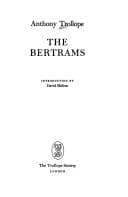
England -- Fiction; Love stories; Scholars -- Fiction
The name of his little book was a very awful name. It was called the
"Romance of Scripture." He began in his first chapter with an earnest
remonstrance against that condemnation which he knew the injustice of
the world would pronounce against him. There was nothing in his book,
he said, to warrant any man in accusing him of unbelief. Let those
who were so inclined to accuse him read and judge. He had called
things by their true names, and that doubtless by some would be
imputed to him as a sin. But it would be found that he had gone no
further in impugning the truth of Scripture than many other writers
before him, some of whom had since been rewarded for their writings
by high promotion in the church. The bishops' bench was the reward
for orthodoxy; but there had been a taste for liberal deans. He had
gone no further, he said, than many deans.
It was acknowledged, he went on to say, that all Scripture statements
could not now be taken as true to the letter; particularly not as
true to the letter as now adopted by Englishmen. It seemed to him
that the generality of his countrymen were of opinion that the
inspired writers had themselves written in English. It was forgotten
that they were Orientals, who wrote in the language natural to them,
with the customary grandiloquence of orientalism, with the poetic
exaggeration which, in the East, was the breath of life. It was
forgotten also that they wrote in ignorance of those natural truths
which men had now acquired by experience and induction, and not by
revelation. Their truth was the truth of heaven, not the truth of
earth. No man thought that the sun in those days did rise and set,
moving round the earth, because a prolongation of the day had been
described by the sun standing still upon Gibeon. And then he took the
book of Job, and measured that by the light of his own candle--and so
on.
The book was undoubtedly clever, and men read it. Women also read it,
and began to talk, some of them at least, of the blindness of their
mothers who had not had wit to see that these old chronicles were
very much as other old chronicles. "The Romance of Scripture" was
to be seen frequently in booksellers' advertisements, and Mr. Mudie
told how he always had two thousand copies of it on his shelves.
So our friend did something in the world; but what he did do was
unfortunately not applauded by his friends.
Harcourt very plainly told him that a man who scribbled never did any
good at the bar. The two trades, he said, were not compatible.
"No," said George, "I believe not. An author must be nothing if he do
not love truth; a barrister must be nothing if he do." Harcourt was
no whit annoyed by the repartee, but having given his warning, went
his way to his work.
Public-domain text, read in full here on John Shaqi.
Reviews
Reviews
No reviews yet
Be the first to share your thoughts on this work.
Elsewhere in the archive
Join the Discussion
Join the discussion
Sign in to leave a comment or review.
Sign InorCreate an account