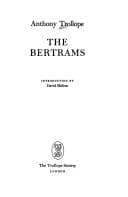
England -- Fiction; Love stories; Scholars -- Fiction
One night she opened her mind to her aunt, and spoke very seriously
of her position. "I hardly know what I ought to do," she said. "I
know how much I owe him; I know how much he has a right to expect
from me. And I would pay him all I owe; I would do my duty by him
even at the sacrifice of myself if I could plainly see what my duty
is."
"But, Caroline, do you wish to give him up?"
"No, not if I could keep him; keep him as he was. My high hopes are
done with; my ambition is over; I no longer look for much. But I
would fain know that he still loves me before I marry him. I would
wish to be sure that he means to live with me. In his present mood,
how can I know aught of him? how be sure of anything?"
Her aunt, after remaining for some half-hour in consideration, at
last and with reluctance gave her advice.
"It all but breaks my heart to say so; but, Caroline, I think I would
abandon it: I think I would ask him to release me from my promise."
It may well be imagined that Miss Waddington was not herself when she
declared that her high hopes were done with, that her ambition was
over. She was not herself. Anxiety, sorrow, and doubt--doubt as to
the man whom she had pledged herself to love, whom she did love--had
made her ill, and she was not herself. She had become thin and pale,
and was looking old and wan. She sat silent for awhile, leaning with
her head on her hand, and made no answer to her aunt's suggestion.
"I really would, Caroline; indeed, I would. I know you are not happy
as you are."
"Happy!"
"You are looking wretchedly ill, too. I know all this is wearing you.
Take my advice, Caroline, and write to him."
"There are two reasons against it, aunt; two strong reasons."
"What reasons, love?"
"In the first place, I love him." Aunt Mary sighed. She had no other
answer but a sigh to give to this. "And in the next place, I have no
right to ask anything of him."
"Why not, Caroline?"
"He made his request to me, and I refused it. Had I consented to
marry him last year, all this would have been different. I intended
to do right, and even now I do not think that I was wrong. But I
cannot impute fault to him. He does all this in order that I may
impute it, and that then he may have his revenge."
Nothing more was said on the matter at that time, and things went on
for awhile again in the same unsatisfactory state.
Public-domain text, read in full here on John Shaqi.
Reviews
Reviews
No reviews yet
Be the first to share your thoughts on this work.
Elsewhere in the archive
Join the Discussion
Join the discussion
Sign in to leave a comment or review.
Sign InorCreate an account