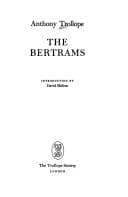
England -- Fiction; Love stories; Scholars -- Fiction
Bertram, as he entered the door, could not but remember how long it
was since he had joined in public worship. Months and months had
passed over him since he had allowed himself to be told that the
Scriptures moved him in sundry places to acknowledge and confess his
sins. And yet there had been a time when he had earnestly poured
forth his frequent prayers to heaven; a time not long removed. It
was as yet hardly more than three years since he had sworn within
himself on the brow of Olivet to devote himself to the service of his
Saviour. Why had that oath been broken? A girl had ridiculed it; a
young girl had dissipated all that by the sheen of her beauty, by the
sparkle of her eye, by the laughter of her ruddy lip. He had promised
himself to his God, but the rustling of silks had betrayed his heart.
At her instance, at her first word, that promise had been whistled
down the wind.
And to what had this brought him now? As for the bright eyes, and
the flashing beauty, and the ruddy lips, they were made over in
fee-simple to another, who was ready to go further than he had gone
in seeking this world's vanities. Even the price of his apostasy had
vanished from him.
But was this all? was this nearly all? was this as anything to that
further misery which had come upon him? Where was his faith now,
his true, youthful, ardent faith; the belief of his inner heart;
the conviction of a God and a Saviour, which had once been to him
the source of joy? Had it all vanished when, under the walls of
Jerusalem, over against that very garden of Gethsemane, he had
exchanged the aspirations of his soul for the pressure of a soft
white hand?
No one becomes an infidel at once. A man who has really believed does
not lose by a sudden blow the firm convictions of his soul. But when
the work has been once commenced, when the first step has been taken,
the pace becomes frightfully fast. Three years since his belief had
been like the ardour of young love, and now what were his feelings?
Men said that he was an infidel; but he would himself deny it with a
frigid precision, with the stiffest accuracy of language; and then
argue that his acknowledgment of a superhuman creative power was not
infidelity. He had a God of his own, a cold, passionless, prudent
God; the same God, he said, to whom others looked; with this only
difference, that when others looked with fanatic enthusiasm, he
looked with well-balanced reason. But it was the same God, he said.
And as to the Saviour, he had a good deal also to say on that
subject; a good deal which might show that he was not so far from
others as others thought. And so he would prove that he was no
infidel.
Public-domain text, read in full here on John Shaqi.
Reviews
Reviews
No reviews yet
Be the first to share your thoughts on this work.
Elsewhere in the archive
Join the Discussion
Join the discussion
Sign in to leave a comment or review.
Sign InorCreate an account