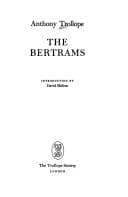
England -- Fiction; Love stories; Scholars -- Fiction
Sir Henry was alive to the delight of being the possessor of so many
charms, and was somewhat chagrined that for the present he was so
cruelly debarred from any part of his legitimate enjoyment. Though
he was a solicitor-general, he could have been content to sit for
ten minutes with his arm round Caroline's waist; and--in spite of
the energy with which he was preparing a bill for the regulation of
County Courts, as to which he knew that he should have that terrible
demi-god, Lord Boanerges, down upon his shoulders--still he would
fain have stolen a kiss or two. But Caroline's waist and Caroline's
kisses were to be his only after Christmas; and to be his only as
payment accorded for her new rank, and for her fine new house in
Eaton Square.
How is it that girls are so potent to refuse such favours at one
time, and so impotent in preventing their exaction at another? Sir
Henry, we may say, had every right to demand some trifling payment in
advance; but he could not get a doit. Should we be violating secrecy
too much if we suggested that George Bertram had had some slight
partial success even when he had no such positive claim--some success
which had of course been in direct opposition to the lady's will?
Miss Baker had now gone back to Littlebath, either to receive Adela
Gauntlet, or because she knew that she should be more comfortable in
her own rooms than in her uncle's dismal house--or perhaps because
Sir Lionel was there. She had, however, gone back, and Caroline
remained mistress for the time of her grandfather's household.
The old man now seemed to have dropped all mystery in the matter. He
generally, indeed, spoke of Caroline as Miss Waddington; but he heard
her talked of as his granddaughter without expressing anger, and
with Sir Henry he himself so spoke of her. He appeared to be quite
reconciled to the marriage. In spite of all his entreaties to George,
all his attempted bribery, his broken-hearted sorrow when he failed,
he seemed to be now content. Indeed, he had made no opposition to the
match. When Caroline had freely spoken to him about it, he made some
little snappish remark as to the fickleness of women; but he at the
same time signified that he would not object.
Why should he? Sir Henry Harcourt was in every respect a good match
for his granddaughter. He had often been angry with George Bertram
because George had not prospered in the world. Sir Henry had
prospered signally--would probably prosper much more signally. Might
it not be safely predicated of a man who was solicitor-general
before he was thirty, that he would be lord-chancellor or lord
chief-justice, or at any rate some very bigwig indeed before he was
fifty? So of course Mr. Bertram did not object.
Public-domain text, read in full here on John Shaqi.
Reviews
Reviews
No reviews yet
Be the first to share your thoughts on this work.
Elsewhere in the archive
Join the Discussion
Join the discussion
Sign in to leave a comment or review.
Sign InorCreate an account