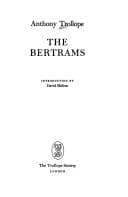
England -- Fiction; Love stories; Scholars -- Fiction
"Yes; I perceived that you were there for a moment," Caroline
answered.
"You were dancing. I don't know that I ever saw you dancing before."
"I have not done so since I was married. In former days I used to be
fond of it."
"Ah, yes; when you were at Littlebath. It did not much matter then
what you did in that way; but--"
"Does it matter more now, Sir Henry?"
"Well, if it would entail no great regret, I would rather that you
did not dance. It is all very nice for girls."
"You do not mean to say that married women--"
"I do not mean to say anything of the kind. One man has one idea, and
another another. Some women also are not placed in so conspicuous a
position as you are."
"Why did you not tell me your wishes before?"
"It did not occur to me. I did not think it probable that you would
dance. May I understand that you will give it up?"
"As you direct me to do so, of course I shall."
"Direct! I do not direct, I only request."
"It is the same thing, exactly. I will not dance again. I should have
felt the prohibition less had I been aware of your wishes before I
had offended."
"Well, if you choose to take it in that light, I cannot help it.
Good-morning. I shall not dine at home to-day."
And so the solicitor-general went his way, and his wife remained
sitting motionless at her dressing-table. They had both of them
already become aware that the bargain they had made was not a wise
one.
CHAPTER V.
CAN I ESCAPE?
Had not George Bertram been of all men the most infirm of purpose, he
would have quitted London immediately after that ball--at any rate,
for many months. But he was lamentably infirm of purpose. He said
to himself over and over again, that it behoved him to go. What had
either of them done for him that he should regard them? That had
hitherto been the question within his own breast; but now it was
changed. Had he not greatly injured her? Had she not herself told
him that his want of mercy had caused all her misery? Ought he not,
at any rate, to spare her now? But yet he remained. He must ask her
pardon before he went; he would do that, and then he would go.
His object was to see her without going to Eaton Square. His instinct
told him that Sir Henry no longer wished to see him there, and he
was unwilling to enter the house of any one who did not wish his
presence. For two weeks he failed in his object. He certainly did see
Lady Harcourt, but not in such a way as to allow of conversation; but
at last fortune was propitious,--or the reverse, and he found himself
alone with her.
She was seated quite alone, turning over the engravings which lay in
a portfolio before her, when he came up to her.
"Do not be angry," he said, "if I ask you to listen to me for a few
moments."
Public-domain text, read in full here on John Shaqi.
Reviews
Reviews
No reviews yet
Be the first to share your thoughts on this work.
Elsewhere in the archive
Join the Discussion
Join the discussion
Sign in to leave a comment or review.
Sign InorCreate an account