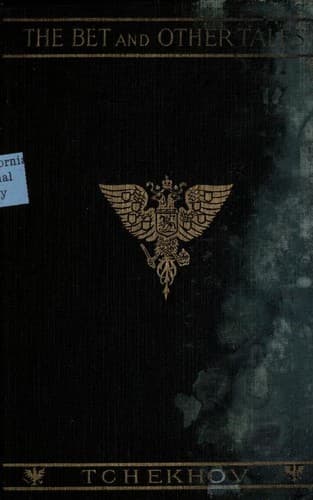
The Bet, and other storiesChekhov, Anton Pavlovich
General
The Bet, and other stories
Chekhov, Anton Pavlovich
Russian fiction -- Translations into English; Short stories, Russian -- Translations into English
“If anything happens ... I shan’t survive it,” he said entering the
hall with the doctor and slowly rubbing his hands in his agitation.
“But I can’t hear any noise. That means it’s all right so far,” he
added, listening to the stillness.
No voices or steps were heard in the hall. For all the bright
illumination the whole house seemed asleep. Now the doctor and Aboguin
who had been in darkness up till now could examine each other. The
doctor was tall, with a stoop, slovenly dressed, and his face was
plain. There was something unpleasantly sharp, ungracious, and severe
in his thick negro lips, his aquiline nose and his faded, indifferent
look. His tangled hair, his sunken temples, the early grey in his long
thin beard, that showed his shining chin, his pale grey complexion
and the slipshod awkwardness of his manners--the hardness of it all
suggested to the mind bad times undergone, an unjust lot and weariness
of life and men. To look at the hard figure of the man, you could not
believe that he had a wife and could weep over his child. Aboguin
revealed something different. He was robust, solid and fair-haired,
with a big head and large, yet soft, features, exquisitely dressed in
the latest fashion. In his carriage, his tight-buttoned coat and his
mane of hair you felt something noble and leonine. He walked with his
head straight and his chest prominent, he spoke in a pleasant baritone,
and in his manner of removing his scarf or arranging his hair there
appeared a subtle, almost feminine, elegance. Even his pallor and
childish fear as he glanced upwards to the staircase while taking off
his coat, did not disturb his carriage or take from the satisfaction,
the health and aplomb which his figure breathed.
“There’s no one about, nothing I can hear,” he said walking upstairs.
“No commotion. May God be good!”
He accompanied the doctor through the hall to a large salon, where a
big piano showed dark and a lustre hung in a white cover. Thence they
both passed into a small and beautiful drawing-room, very cosy, filled
with a pleasant, rosy half-darkness.
“Please sit here a moment, Doctor,” said Aboguin, “I ... I won’t be a
second. I’ll just have a look and tell them.”
Kirilov was left alone. The luxury of the drawing-room, the pleasant
half-darkness, even his presence in a stranger’s unfamiliar house
evidently did not move him. He sat in a chair looking at his hands
burnt with carbolic acid. He had no more than a glimpse of the bright
red lampshade, the cello case, and when he looked sideways across the
room to where the clock was ticking, he noticed a stuffed wolf, as solid
and satisfied as Aboguin himself.
It was still.... Somewhere far away in the other rooms someone uttered
a loud “Ah!” A glass door, probably a cupboard door, rang, and again
everything was still. After five minutes had passed, Kirilov did not
look at his hands any more. He raised his eyes to the door through
which Aboguin had disappeared.
Public-domain text, read in full here on John Shaqi.
Reviews
Reviews
No reviews yet
Be the first to share your thoughts on this work.
Elsewhere in the archive
Join the Discussion
Join the discussion
Sign in to leave a comment or review.
Sign InorCreate an account