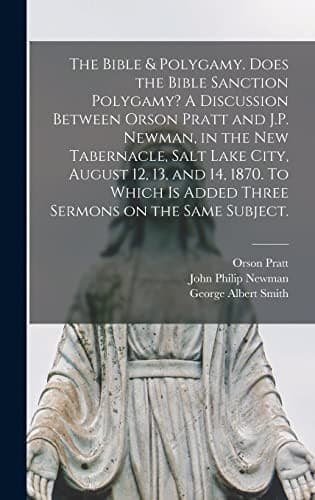
The Bible and Polygamy: Does the Bible Sanction Polygamy?Newman, John Philip
Religion
The Bible and Polygamy: Does the Bible Sanction Polygamy?
Newman, John Philip
Bible -- Criticism, interpretation, etc.; Latter Day Saint churches -- Doctrines; Polygamy -- Religious aspects
Now, instead of God blessing Rachel and Jacob and their offspring,
as we are told He did, we might have expected something entirely
different, had it not been that God was pleased with and approbated and
sustained a plurality of wives.
While we are considering this subject, we will enquire, did the Savior
in any place that we read of, in the course of His mission on the
earth, denounce a plurality of wives? He lived in a nation of Jews;
the law of Moses was in force, plurality of wives was the custom, and
thousands upon thousands of people, from the highest to the lowest in
the land, were polygamists. The Savior denounced adultery; He denounced
fornication; He denounced lust; also, divorce; but is there a single
sentence asserting that plurality of wives is wrong? If so, where is
it? Who can find it? Why did He not say it was wrong? "Think not," said
He, "that I am come to destroy the law or the Prophets. I am not come
to destroy, but to fulfil. Not one jot or one tittle shall pass from
the law and the Prophets, but all shall be fulfilled." Of what does the
Savior speak when He refers to "the law?" Why, of the Ten Commandments,
and other rules of life commanded by God and adopted by the ancients,
and which Bro. Pratt referred to yesterday, showing you from the
sacred book that God legislated and made laws for the protection of a
plurality of wives, (Exod. 21, 10) and that He commanded men to take a
plurality under some circumstances. Brother Pratt further showed that
the Lord made arrangements to protect, to all intents and purposes, the
interests of the first wife; and to shield and protect the children
of a wife from disinheritance who might be unfortunate enough not to
have the affections of her husband. (Deut., 21.15.) These things were
plainly written in the law--that law of which the Savior says "not
one jot or one tittle shall pass away." Continuing our inquiry, we
pass on to the epistles of John the Evangelist, which we find in the
book of Revelations, written to the seven churches of Asia. In them we
find the Evangelist denounces adultery, fornication, and all manner
of iniquities and abominations of which these churches were guilty.
Anything against a plurality of wives? No; not a syllable. Yet those
churches were in a country in which plurality was the custom. Hundreds
of Saints had more wives than one; and if it had been wrong, what would
have been the result? Why, John would have denounced the practice, the
same as the children of Israel were denounced for marrying heathen
wives, had it not been that the law of plurality was the commandment of
God.
Public-domain text, read in full here on John Shaqi.
Reviews
Reviews
No reviews yet
Be the first to share your thoughts on this work.
Elsewhere in the archive
Join the Discussion
Join the discussion
Sign in to leave a comment or review.
Sign InorCreate an account