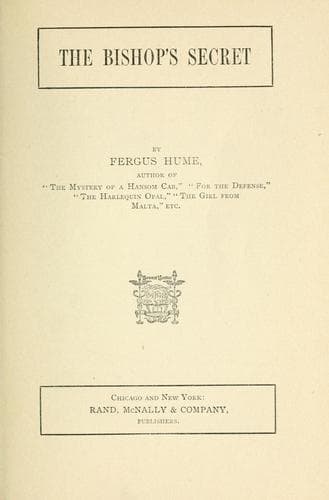
Clergy -- England -- Fiction; Detective and mystery stories
'Not that he would have married her if he could have helped it,' went on
Miss Whichello, while the bishop looked at the documents, 'but Annie had
a little money--not much--which she was to receive on her wedding day,
so the wretch married her and wrote to my dear father for the money,
which, of course, under grandfather's will, had to be paid. Father never
would see Annie again, but when the poor darling wrote to me a year
afterwards that she was dying with a little child by her side, what
could I do but go and comfort her? Ah, poor darling Annie!' sobbed the
little old lady, 'she was sadly changed from the bright, beautiful girl
I remembered. Her husband turned out a brute and a ruffian and a
spendthrift. He wasted all her money, and left her within six months of
the marriage--the wretch! Annie tried to support herself by needlework,
but she took cold in her starving condition and broke down. Then Mab was
born, and she wrote to me. I went at once, bishop, but arrived just in
time to get those papers and close my dear Annie's eyes. Afterwards I
brought Mab back with me to Beorminster, but I kept her for some time in
London on account of my father. When I did bring her here, and I showed
him the marriage certificate, he got quite fond of the little pet. So
all these years Mab has lived with me quite like my own sweet child, and
your son is a lucky man to win her love,' added the old maid, rather
incoherently. 'It is not everyone that I would give my dear Annie's
child to, I can tell you, bishop. So that's the whole story, and a sadly
common one it is.'
'It does you great credit, Miss Whichello,' said Dr Pendle, patting her
hand; 'and I have the highest respect both for you and your niece. I am
proud, my dear lady, that she should become my daughter. But tell me how
your unhappy sister became acquainted with this man?'
'He was a violinist,' replied Miss Whichello, 'a public violinist, and
played most beautifully. Annie heard him and saw him, and lost her head
over his looks and genius. He called himself Amaru, but his real name
was Pharaoh Bosvile.'
'A strange name, Miss Whichello.'
'It is a gipsy name, bishop. Bosvile was a gipsy. He learned the violin
in Hungary or Spain, I don't know which, and played wonderfully.
Afterwards he had an accident which hurt his hand, and he could not
play; that was the reason he married Annie--just for her money, the
wretch!'
'A gipsy,' murmured the bishop, who had turned pale.
'Yes; an English gipsy, but like all those people he wandered far and
near. The accident which hurt his hand also marked his cheek with a
scar.'
'The right cheek?' gasped Dr Pendle, leaning forward.
'Why, yes,' said Miss Whichello, rather astonished at the bishop's
emotion; 'that was how I recognised him here when he called himself
Jentham. He--'
With a cry the bishop sprang to his feet in a state of uncontrollable
agitation, shaking and white. 'W--was Jentham--Bos--Bosvile?' he
stammered. 'Are--are you sure?'
Public-domain text, read in full here on John Shaqi.
Reviews
Reviews
No reviews yet
Be the first to share your thoughts on this work.
Elsewhere in the archive
Join the Discussion
Join the discussion
Sign in to leave a comment or review.
Sign InorCreate an account