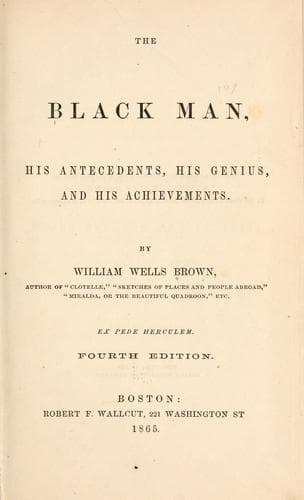
The Black Man: His Antecedents, His Genius, and His AchievementsBrown, William Wells
History
The Black Man: His Antecedents, His Genius, and His Achievements
Brown, William Wells
African Americans -- Biography
At the breaking out of the rebellion, Robert Small was a slave in
Charleston, S. C. He stood amid a group of his fellow-slaves, as the
soldiers were getting ready to make the assault upon Fort Sumter,
and he said to his associates, "This, boys, is the dawn of freedom
for our race." Robert, at this time, was employed as pilot on board
the steamboat "Planter," owned at Charleston, and then lying at her
dock. The following day, the steamer commenced undergoing alterations
necessary to fit her for a gunboat. Robert, when within hearing of
the whites, was loud in his talk of what "we'll do with the Yankees,
when this boat is ready for sea." The Planter was soon transmogrified
into a rebel man-of-war, to be used in and about the rivers and bays
near Charleston, and Robert Small was her acknowledged pilot. One of
Robert's brothers was second engineer, and a cousin to him was the
second mate; the remainder of the crew were all slaves, except the
white officers. It was the custom of the captain, chief mate, and chief
engineer to spend the night with their families in the city, when the
steamer was in port, the vessel being left in charge of Robert. The
following is the account of the capture of the boat by her black crew,
as given by the Port Royal correspondent of the _New York Commercial
Advertiser_:--
"The steamer Planter, which was run away from the rebels by her pilot,
Robert Small, is a new tug boat employed about Charleston harbor, which
was seized by the Confederate government and converted into a gunboat,
mounting a rifled gun forward and a siege gun aft. She has been in the
habit of running out to sea to reconnoitre, and was, therefore, no
unusual appearance near the forts guarding the entrance. Small, the
helmsman and pilot, conceived the idea of running away, and plotted
with several friends, slaves like him, to take them off.
"On the evening of May 11, her officers left the ship, then at the
wharf in Charleston, and went to their homes. Small then took the
firemen and assistant engineers, all of whom were slaves, in his
confidence, had the fires banked up, and every thing made ready to
start by daylight.
"At quarter to four on Saturday morning, the lines which fastened the
vessel to the dock were cast off, and the ship quietly glided into the
stream. Here the harbor guard hailed the vessel, but Small promptly
gave the countersign, and was allowed to pass.
"The vessel now called at a dock a distance below, where the families
of the crew came on board.
"When off Fort Sumter, the sentry on the ramparts hailed the boat, and
Small sounded the countersign with the whistle--three shrill sounds and
one hissing sound. The vessel being known to the officers of the day,
no objection was raised, the sentry only singing out, 'Blow the d----d
Yankees to hell, or bring one of them in.' 'Ay, ay,' was the answer,
and every possible effort was made to get below.
Public-domain text, read in full here on John Shaqi.
Reviews
Reviews
No reviews yet
Be the first to share your thoughts on this work.
Elsewhere in the archive
Join the Discussion
Join the discussion
Sign in to leave a comment or review.
Sign InorCreate an account