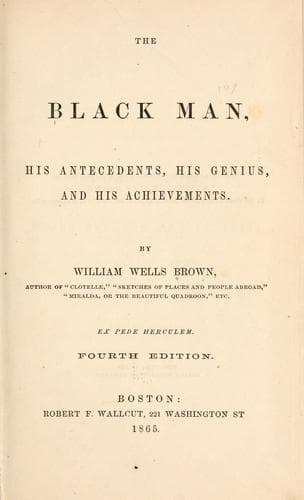
The Black Man: His Antecedents, His Genius, and His AchievementsBrown, William Wells
History
The Black Man: His Antecedents, His Genius, and His Achievements
Brown, William Wells
African Americans -- Biography
Nothing can be more touching than Miss Forten's allusion to her sainted
mother. In some of her other poems she is more light and airy, and her
muse delights occasionally to catch the sunshine on its aspiring wings.
Miss Forten is still young, yet on the sunny side of twenty-five, and
has a splendid future before her. Those who know her best consider her
on the road to fame. Were she white, America would recognize her as one
of its brightest gems.
WILLIAM H. SIMPSON.
It is a compliment to a picture to say that it produces the impression
of the actual scene. Taste has, frequently, for its object works of
art. Nature, many suppose, may be studied with propriety, but art
they reject as entirely superficial. But what is the fact? In the
highest sense, art is the child of nature, and is most admired when
it preserves the likeness of its parent. In Venice, the paintings of
Titian, and of the Venetian artists generally, exact from the traveller
a yet higher tribute, for the hues and forms around him constantly
remind him of their works. Many of the citizens of Boston are often
called to mention the names of their absent or departed friends, by
looking upon their features, as transferred to canvas by the pencil and
brush of William H. Simpson, the young colored artist. He has evidently
taken Titian, Murillo, and Raphael for his masters. The Venetian
painters were diligent students of the nature that was around them.
The subject of our sketch seems to have imbibed their energy, as well
as learned to copy the noble example they left behind. The history of
painters, as well as poets, is written in their works. The best life
of Goldsmith is to be found in his poem of "The Traveller" and his
novel of "The Vicar of Wakefield." No one views the beautiful portrait
of J. P. Kemble, in the National Gallery in London, in the character
of Hamlet, without thinking of Sir Thomas Lawrence, who executed it.
The organ of color is prominent in the cranium of Mr. Simpson, and
it is well developed. His portraits are admired for their life-like
appearance, as well as for the fine delineation which characterizes
them all. It is very easy to transcribe the emotions which paintings
awaken, but it is no easy matter to say why a picture is so painted
as that it must awaken certain emotions. Many persons feel art, some
understand it, but few both feel and understand it. Mr. Simpson is
rich in depth of feeling and spiritual beauty. His portrait of John T.
Hilton, which was presented to the Masonic Lodge a few months since,
is a splendid piece of art. The longer you look on the features, the
more the picture looks like real life. The taste displayed in the
coloring of the regalia, and the admirable perspective of each badge
of honor, shows great skill. No higher praise is needed than to say
that a gentleman of Boston, distinguished for his good judgment in the
picture gallery, wishing to secure a likeness of Hon. Charles Sumner,
induced the senator to sit to Mr.
Public-domain text, read in full here on John Shaqi.
Reviews
Reviews
No reviews yet
Be the first to share your thoughts on this work.
Elsewhere in the archive
Join the Discussion
Join the discussion
Sign in to leave a comment or review.
Sign InorCreate an account