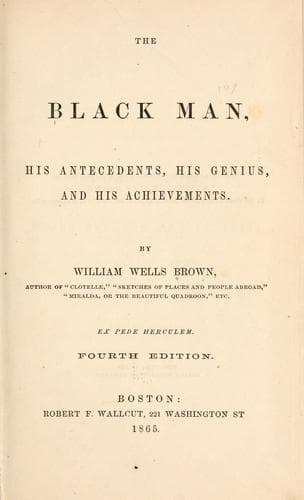
The Black Man: His Antecedents, His Genius, and His AchievementsBrown, William Wells
History
The Black Man: His Antecedents, His Genius, and His Achievements
Brown, William Wells
African Americans -- Biography
Jean Pierre Boyer was born at Port au Prince on the 2d of February,
1776; received in Paris the advantages of European culture; fought
under Rigaud against Toussaint; and in consequence of the success of
the latter, quitted the island. Boyer returned to Hayti in Leclerc's
expedition: he, however, separated from the French general-in-chief,
placed himself at the head of his own color, and aided in vindicating
the claims of his race to freedom in the last struggle with the French.
On the death of Dessalines, Christophe, already master of the north,
sought to take the south out of the hands of Petion. Boyer assisted his
fellow-mulatto in driving off the black general. This act endeared him
to the former. Gratitude, as well as regard to the common interest,
gave Boyer the president's chair, on the death of Petion. Raised to
that dignity, he employed his power and his energies to complete those
economical and administrative reforms with which he had already been
connected under his predecessor. To labor for the public good was the
end of his life. In this worthy enterprise he was greatly assisted,
no less by his knowledge than his moderation. Well acquainted with
the character of the people that he was called to govern, conversant
with all the interests of the state, he had it in his power to effect
his purpose by mild as well as judicious measures. Yet were the
wounds deep which he had to heal; and he could accomplish in a brief
period only a small part of that which it will require generations to
carry to perfection. At the death of Christophe, in 1820, Boyer was
proclaimed president of the north and south. In 1822, the Spanish part
of the island, with its own accord, joined the republic; and thus,
from Cape Tiburn to Cape Engano, Hayti was peacefully settled under
one government, with Boyer at its head. At length, in 1825, after the
recognition of Hayti by others, the French, under Charles X., sold
to its inhabitants the rights which they had won by their swords,
for the sum of one hundred and fifty millions of francs, to be paid
as an indemnity to the old planters. The peace with France created a
more fraternal feeling between the two countries, and Hayti now began
to regain her ancient commercial advantages, and every thing seemed
prosperous. In the year 1843, a party opposed to the president made
its appearance, which formed itself into a conspiracy to overthrow the
government. Seeing that he could not make head against it, Boyer, in
disgust, took leave of the people in a dignified manner, and retired to
Jamaica, where, a few years since, he died.
Public-domain text, read in full here on John Shaqi.
Reviews
Reviews
No reviews yet
Be the first to share your thoughts on this work.
Elsewhere in the archive
Join the Discussion
Join the discussion
Sign in to leave a comment or review.
Sign InorCreate an account